My Dark & Light Side
Test Results
Provides an honest look at attitudes, exploring moral complexity and both positive and negative aspects of personality.
Official website: 16personalities.com/specialized-tests/trait-greyDetailed results of my assessment
Dark & Light Side
Test taken on December 4, 2025
Dark & Light Side
Exploring my moral complexity and personality duality
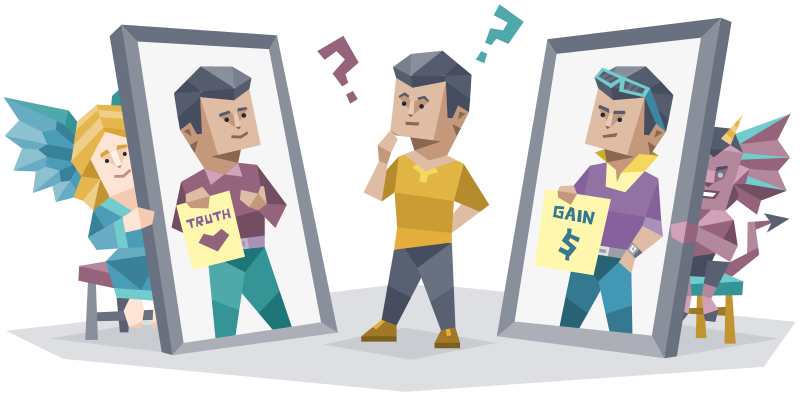
This test provides me with an honest look at my attitudes, exploring the moral complexity of my personality. It reveals both my positive and negative aspects, allowing me to better understand how I navigate the ethical and moral dilemmas of everyday life.
« I am both light and shadow. »
I consider myself honest in my interactions, but I recognize that absolute truth isn't always my first instinct. In certain situations, I adjust the truth to protect others or to avoid unnecessary conflicts. This isn't malicious dishonesty, but rather a form of social diplomacy.
I'm not the type to lie blatantly, but I admit that I can sometimes embellish reality or omit certain details. My tendency toward selective honesty comes from my desire to maintain harmony and not unnecessarily hurt the people around me.
In the professional world, I value transparency, but I also know when it's strategic to withhold certain information. This ability to navigate between pure honesty and calculated discretion allows me to be effective while staying aligned with my core values.
« My truth is flexible, but never malicious. »
Most people fall somewhere between absolute honesty and deliberate deception. This gray area enables social navigation while preserving personal integrity.
I deeply feel the emotions of others, sometimes even in an overwhelming way. My empathy is a strength that allows me to connect authentically with people, to understand their struggles and offer meaningful support.
However, I recognize that my empathy has its limits. In certain situations, particularly when I'm under pressure or stressed, I can become more emotionally detached. This isn't a lack of empathy, but rather a protective mechanism to preserve my own mental health.
I'm capable of setting aside my emotions to make rational decisions when the situation requires it. This ability to switch between deep empathy and strategic detachment allows me to be both compassionate and effective in my professional roles.
« I feel deeply, but I also know when to protect myself. »
Empathy isn't binary. It exists on a spectrum, and the ability to modulate one's level of empathy according to context is often a sign of emotional maturity.
I'm proud of my accomplishments, but I don't feel the need to constantly display them. My self-confidence comes from within, and I don't need constant external validation to feel valued.
However, I recognize that I appreciate recognition when it comes. I'm not immune to the pleasure of being appreciated for my work and contributions. This recognition motivates me and pushes me to excel further.
I strive to maintain a balance between authentic humility and asserting my worth. I know how to recognize my strengths without falling into arrogance, and I'm equally aware of my weaknesses and areas for improvement. This self-awareness keeps me grounded while pursuing excellence.
« I know my worth without needing to shout it. »
The balance between modesty and self-confidence is delicate. Healthy self-esteem allows one to acknowledge accomplishments without sliding into vanity.
This test reveals that I am a complex being, with moral nuances that reflect human reality. I am neither entirely good nor entirely bad, but rather a dynamic combination of light and shadow.
Understanding these aspects of my personality allows me to navigate more consciously through my ethical choices and develop greater personal integrity. I accept my moral complexity as an integral part of my humanity.
« I embrace all facets of who I am. »