Contact
Let's work together
Enterprise Integration Platform - Engineering Manager Leadership

Enterprise Integration Platform - Engineering Manager Leadership

Led a team of 1 to 7 developers managing 100+ data flows across 20+ business applications on Tibco BusinessWorks ESB for a 1,400-employee real estate group - capacity planning, Agile ceremonies, vendor negotiation, and ~370K EUR annual budget.

2019 - March 2024
~5 years (3 years as leader)
Technical Lead to Engineering Manager - Enterprise Integration
Tibco BusinessWorks 6SOFT MonitorELK StackMongoDB AtlasFTP/SFTPPGPGitLab CIPowerAppsJiraConfluenceMicrosoft Teams

Connected Systems

20+

Business applications interconnected

Production Flows

50+

Distinct technical data flows

Jira Tickets

980+

ESB-2 to ESB-986+

SOFT Monitor Alerts

2,377

Monitored and processed

Presentation

Project definition and scope

The Enterprise Integration Platform (also known as ESB - Enterprise Service Bus) of Groupe Pichet was the central nervous system of the entire information system. Built on Tibco BusinessWorks 6, it orchestrated all data flows between 20+ business applications: accounting ERP (Qualiac/Cegid XRP), financial software (SAGE), treasury management (KYRIBA), hotel PMS (MEWS, formerly HOMING), real estate management (PRIMPROMO), CRM (Hermes), PIM (Akeneo), DAM (Bynder), marketing automation (Adobe Campaign/Neolane), document dematerialization (ESKER), digital identity management (IGA), time tracking (HOROQUARTZ), HRIS (FOEDERIS), fleet management (WINFLOTTE), and many others.

As Engineering Manager for Enterprise Integration, I managed a team of 1 to 7 developers (internal staff and contractors from Square IT / RS2I). I created and facilitated all Agile ceremonies (Daily, Sprint Planning, Sprint Review, Sprint Retrospective), drove the ESB roadmap for 2022-2024, managed vendor relationships, and supervised all production flows.

This role required interaction with every department and business unit of Groupe Pichet (~1,400 employees), as each data flow represented a critical business process. I interacted with at least 80 people on a daily basis on entirely diverse subjects.

Business Domain

Real estate (new construction, investment, rental, hospitality, student residences, commercial) - Enterprise middleware integration

Impacted Users

All Groupe Pichet departments: Finance, Accounting, Treasury, HR, Marketing, Real Estate Promotion, Rental, Hospitality, Security, IT (~1,400 employees)

Integration Scope
Accounting (Qualiac/SAGE)
Treasury (KYRIBA)
Hospitality (MEWS/D-Edge)
Real Estate (PRIMPROMO)
Identity & Access (IGA)
Marketing (Akeneo/Bynder)
HR (HOROQUARTZ/FOEDERIS)
Dematerialization (ESKER)
Fleet & Services (WINFLOTTE)
ESB Architecture - Hub & Spoke
Tibco BusinessWorks 6 ESB connecting 20+ business applications across all departments
IS Ecosystem - Enterprise Interconnections

Overview of interconnected systems via the TIBCO BusinessWorks ESB platform at Groupe Pichet (1,400+ employees). Each flow represents a critical business process linking IT divisions to operational departments.


Connected Systems by Business Domain

Objectives, Context, Stakes & Risks

Strategic vision and constraints

Objectives
  • Manage the middleware team (1 to 7 developers) with complete Agile ceremonies (Daily, Sprint Planning, Review, Retrospective)
  • Drive the ESB roadmap 2022-2024 in collaboration with business units and IT leadership
  • Guarantee availability of 50+ production flows (24/7 for accounting flows)
  • Integrate new flows requested by business units (MEWS, KYRIBA, TITAN, ESKER, FOEDERIS, CAMILEIA...)
  • Modernize infrastructure: evaluate iPaaS solutions (Middleway SAS, RS2I/TIBCO Cloud), implement CI/CD, replace SoftMonitor with ELK stack
  • Manage knowledge transfer after the departure of the former ESB lead and ensure service continuity
Context

Groupe Pichet is a family-owned real estate group headquartered in Pessac (Bordeaux metropolitan area), with approximately 1,400 employees. Operating across new construction, investment, rental, hospitality, student residences, and commercial real estate, the group relied on a complex IT landscape with 20+ specialized applications that needed to communicate seamlessly.

The ESB platform had accumulated significant technical debt: instability on the TIBCO BW infrastructure was identified as a critical issue during the HELIOS project (the group's IT transformation program launched in 2022). The former ESB team lead (Jean-Francois) was departing, requiring a complete knowledge transfer of dozens of complex data flows. The monitoring system (SOFT Monitor) generated 2,377 alerts that required systematic processing and triage.

Business Stakes

Critical Business Impact

An ESB outage blocks accounting entries (Qualiac/SAGE), student billing (MEWS/KYRIBA), CRM leads (Hermes), pricing updates on websites, and identity management (IGA) - every flow failure has direct business impact

System Complexity

50+ distinct technical flows, each with its own transformation rules, execution schedules, and recipients. Cross-cutting dependencies between 12+ business departments

Regulatory Compliance

Financial flows (Qualiac/SAGE) are subject to strict accounting and regulatory constraints. Zero tolerance for data inconsistency in financial reporting

Identified Risks

Infrastructure Instability

TIBCO BW infrastructure experienced recurring instability episodes. HELIOS identified this as a priority issue: "too much instability on TIBCO BW infra, new platform desired: simpler, faster, less expensive".

Knowledge Concentration

Critical ESB knowledge was concentrated in a single person (Jean-Francois). His departure required ~10 dedicated knowledge transfer sessions to avoid service disruption.

Alert Fatigue

With 2,377 SOFT Monitor alerts in the mailbox, there was a real risk of alert fatigue - critical failures buried among routine notifications.

Vendor Lock-in

Heavy dependency on Square IT for TMA (maintenance) and RS2I for TIBCO expertise. Contract negotiations and vendor management required constant attention.

Capacity Planning & Resource Constraints

The reality of demand vs available capacity

The 2023 roadmap exercise revealed a stark reality: 903 days of work across all perimeters for a team of 2 FTEs (420 available days). That is a 4.3 FTE demand for 2 FTE capacity - the gap was documented and presented to IT leadership as a structural constraint.

This forced rigorous prioritization: every flow request had to be qualified by complexity, estimated in days, and ranked against competing demands from 8+ business teams.

Demand vs Capacity (working days/year)

903

days demand

vs

420

days capacity (2 FTE)

4.3 FTE

needed vs 2 available

Flow Costing Model

ComplexityDEV (incl. TMA)CP/PO (incl. UAT)Total consumed
Simple3d2d5d
Medium6d4d10d
Complex12d8d20d

Model I created from scratch - used for all flow estimates presented to business stakeholders

Build vs Run Ratio

44% Build / 56% Run - showing the weight of operational maintenance on the integration perimeter

The Steps - What I Did

Chronological phases and personal contributions

Flow Coverage Over Time (cumulative active flows)
Phase 1
Progressive Onboarding
2019 - 2021
  • First ESB alerts received and analyzed - gained access to distribution lists
  • Requested and obtained admin access to DEV1/DEV2/RECETTE environments
  • Created the Jira ESB workspace (KESD-19493) to centralize all integration tickets
  • Launched first COPROJ PIM/ESB meetings: planning, action plans, RACI matrices
  • Completed BW6 and Soft Monitor training with Square IT Services (Pierre ARICO)
  • Drove the Soft Monitor platform upgrade - cross-impact analysis and UAT
  • Started Confluence ESB documentation: Qualiac flows, IGA flows, Soft Monitor access guides
Phase 2
Full Responsibility & Team Building
2022
  • Created the Daily Integration d'Entreprise (ESB) - organized and facilitated daily standups
  • Established COPROJ Integration d'Entreprise and Weekly SI Finance/RH/Transverse meetings
  • Built the ESB flux costing process - first estimate: EMMA_QUAL_01 at 3,375 EUR (7.5d Kalala + 2.5d Jose)
  • Led 8 HELIOS monitoring workshops with each IT team (rental, accounting, hotel, real estate, security, infra)
  • Managed complete knowledge transfer from departing ESB lead (~10 dedicated sessions)
  • Conducted iPaaS audit: evaluations with Middleway SAS and RS2I/TIBCO Cloud
  • First Sprint Review: multi-project Sprint Backlog presentation, complexity grading, 2023 flow planning
Phase 3
Engineering Manager - Full Agile
Oct 2023 - Mar 2024
  • Launched complete Agile ceremonies for the middleware team: Sprint Planning, Review, Retrospective
  • Drove ESB roadmap 2023-2024 with business stakeholders and IT leadership
  • Managed KYRIBA migration (lots 1/2/3): SAGE to KYRIBA treasury flows with PGP decryption
  • Coordinated critical Qualiac I3 API migration: SOAP to REST - cross-impact on all financial flows
  • Supervised new integrations: FOEDERIS HRIS, CAMILEIA, IGA connector evolution
  • Managed structured knowledge transfer before departure: 10+ sessions covering PIM, DAM, PSR MCO, Ligneurs, ESB
  • Led Akeneo PIM contract renegotiation (45K to 60K EUR/year over 3 years - flagged 30% increase)
Multi-Team Requirements Collection

Collecting, qualifying, and prioritizing demands from 8 business teams

Requirements Pipeline

Flow Demands by Team (Retained vs Postponed)

From the 2023 roadmap: 84 flows requested across 8 teams, 65 retained for execution, 19 postponed due to capacity constraints. Each postponement required direct communication with the requesting department head and formal justification in COPROJ.

Scope Management & Prioritization

Active scope control under resource constraints

52

Planned Flows

45

Retained

7

Postponed

Prioritization Criteria

Business criticality: Financial flows (Qualiac/SAGE) and regulatory flows always took priority - zero tolerance for accounting inconsistencies.

Cross-dependencies: Flows blocking other teams were escalated (e.g., IGA identity provisioning blocked security, HR, and fleet management).

Team capacity: Simple flows (5 days) were batched together; complex flows (20 days) required dedicated sprint allocation.

Budget availability: Some items were "retired from roadmap 2023" when the budget was not approved - these were flagged in orange in the Confluence roadmap.

Communication of Postponements

Every postponement followed a structured process: notification in COPROJ, formal entry in Jira with justification, and direct conversation with the department head. Transparency was key to maintaining trust - business stakeholders accepted delays when they understood the constraints and saw the prioritization logic.

Technical Documentation Produced

Complete documentation corpus following ITIL standards and Technical Direction requirements (APP-241 ESB)

37

documents produced

DAA5 documents

Application Architecture Document

Interactions and data flows between the ESB and satellite applications (QUALIAC, PRIMPROMO, HOMING, SAGE XRT, TEAMS RH, ANAPLAN). Exchange choreography, access permissions, flow trigger schedules, deployment prerequisites.

DAT1 document

Technical Architecture Document

Complete inventory of physical system components: servers (hostnames, IPs, CPU, RAM, OS), network flows, ports and protocols, high availability, security and performance constraints per environment.

DAU1 document

Automation Document

CI/CD pipeline management guide for ESB Eclipse projects: Azure DevOps configuration, YAML pipelines, Maven artifacts, Git branch management and environment variables.

DEX4 documents

Operations Document

Operational guide for the ESB platform: package deployment, configuration file management (properties, templates), TIBCO component troubleshooting (TEA, BW6, EMS) across 5 environments.

DFX13 documents

Flow Specification Document

Detailed integration flow specs by business domain: SOFTMONITOR, budget, accounting, hospitality, marketing (D-Edge), real estate (PRIMPROMO), HR, transcoding, treasury (SAGE). Includes SQL scripts and transcoding files.

DIN4 documents

Installation Document

Step-by-step installation procedures for TIBCO and Square IT Services on pre-production and production: hardware prerequisites (VM, vCPU, RAM), software (JDK, Visual C++), network config and rollback procedures.

DMI4 documents

Migration Document

ESB version upgrade procedures (BW 6.4 to 6.5.1, EMS 8.3 to 8.5): incompatible component removal, new version installation, configuration migration and post-migration verification with rollback plans.

SCHEMAS5 documents

Architecture Diagrams

Visio diagrams of ESB infrastructure per environment (production, pre-production, staging) and DevOps/CI-CD processes: Git workflows, Azure DevOps pipelines, TIBCO BW6 deployment.

Key Data Flow - Financial & Hospitality
Sequence diagram showing critical data flows between Qualiac, SAGE, MEWS, KYRIBA, and IGA through the ESB
ESB Roadmap 2022-2024

Major workstreams managed across 3 years

Actors & Interactions

Team, stakeholders, and collaboration dynamics

Team Organization
Organizational structure: hierarchy, middleware team, and vendor relationships
Middleware Team (Managed by Jose)

I created and led the middleware team starting May 2022. The team fluctuated between 4 and 7 developers depending on project phases and contractor availability. I organized all team rituals from scratch and established a structured Agile workflow.

MemberStatusRole
Mulamba K.Square IT (contractor)ESB Developer (e.g. EMMA_QUAL_01 - 7.5d effort)
Achraf L.ExternalESB Developer - joined Daily Nov 2023
Melissa B.Internal/ExternalTIBCO access (KESD-72785)
Square IT / RS2I devsContractorsTMA and flow development

The team composition posed unique challenges: mixing internal staff with contractors from two different companies (Square IT and RS2I) required careful coordination to maintain code quality, knowledge sharing, and team cohesion. I implemented pair reviews between internal and external developers to bridge knowledge gaps.

People Management Practices

Structured Onboarding

Achraf L. joined the Daily in November 2023 and was operational on critical flows within weeks. The onboarding included paired work sessions with senior team members, progressive access to environments (DEV -> PREPROD -> PROD), and a dedicated Confluence onboarding guide covering each flow family.

Cross-Company Pair Reviews

I set up systematic code reviews pairing internal developers with Square IT and RS2I contractors. This bridged knowledge gaps and prevented silos from forming along company boundaries. Each flow modification required review from at least one person outside the author's company.

Multi-Company Team Cohesion

Managing a team spanning 3 companies (Groupe Pichet internal, Square IT, RS2I) required explicit working agreements: shared Jira board, common Git branching strategy, unified definition of done, and daily standups where company affiliation was irrelevant. I treated everyone as one team.

Mentoring & Growth

I accompanied junior and intermediate profiles on TIBCO BW integration patterns, helped them understand the business context behind each flow, and encouraged them to present their work during Sprint Reviews to build their confidence and visibility.

Team Evolution Over Time
Key Stakeholders

Claude D.

N+1 - IT Project Director, PSI Pole. Validated budgets, reviewed ESB roadmap, attended Sprint Reviews

Jean-Luc O.

N+2 - Business IS Director. Strategic oversight of middleware investments

Jean-Francois (ESB Lead)

Former ESB lead - ~10 knowledge transfer sessions before departure (Sep 2022)

Business Department Heads

12+ department heads (Finance, HR, Marketing, Real Estate...) - each owning critical data flows

Square IT / RS2I / Middleway

External vendors - TMA, development, iPaaS consulting

HELIOS Program Team

Emilie F., Cyril M., Sebastien B., Bertrand D.

Agile Ceremonies Established
CeremonyFrequencyStarted
Daily Integration d'EntrepriseDailyMay 2022
Weekly SI Finance / RH / TransverseWeeklyApril 2022
COPROJ Integration d'EntrepriseBi-monthlyMay 2022
Sprint PlanningPer sprintFebruary 2023
Sprint ReviewPer sprintNovember 2022
Sprint RetrospectivePer sprintFebruary 2023

Results - For Me, For the Company

Measurable outcomes and business impact

Data Flows by Domain
Operational Performance Indicators

DORA-inspired metrics for the ESB platform (estimates based on project data)

< 4h

MTTR

Mean time to recovery for critical flow incidents

~2/month

Deploy Frequency

New flow deployments to production

~15%

Change Failure Rate

Percentage of deploys requiring hotfix

5-20 days

Lead Time

From business request to production deployment

Estimates based on Jira ticket analysis (980+ tickets) and SOFT Monitor alert patterns (2,377 alerts). Not measured with automated DORA tooling - derived from operational experience.

Annual Budget Allocation (~370K EUR)
HELIOS Workshop Coverage by Department
HELIOS Workshop Details

Teams Audited

Location (Rental)
Comptabilite (Accounting)
Hotellerie (Hospitality)
Parcours Client (Customer Journey)
Promotion (Real Estate)
Securite (Security)
Urbanisation (Architecture)
IT/Direction Technique

Concrete Outputs

Each workshop produced a monitoring needs map per department: which flows are critical, what SLAs are expected, who should be alerted, and what recovery procedures exist. These maps fed directly into the HELIOS IT transformation roadmap and influenced investment decisions for 2023-2024.

Strategic Value

Running 8 workshops with every DSI team required speaking each department's language - financial terms with accounting, occupancy rates with hospitality, compliance vocabulary with security. This exercise was recognized by IT leadership as a model approach, later replicated for other transformation perimeters.

Budget Management & Vendor Negotiation

Flow Costing from Scratch

I built the first costing model for ESB flows. The inaugural estimate - EMMA_QUAL_01 at 3,375 EUR (7.5 dev days + 2.5 CP/PO days) - became the reference template for all subsequent flow estimates presented to business stakeholders and validated by IT leadership.

Purchase Orders & OPEX

35 purchase orders issued (Feb 2021 - May 2022) totaling 168K EUR documented spend. Monthly infrastructure OPEX: 18K EUR/month for Docker/Kubernetes hosting (216K EUR/year).

Contract Negotiation - Akeneo PIM

During the Akeneo PIM contract renewal, I flagged a 30% price increase (45K to 60K EUR/year) to my N+1 Claude D. and IT leadership. I negotiated a 3-year commitment to lock in the rate and produced a detailed cost-benefit analysis comparing the renewal against alternative PIM solutions.

For Me - Personal Growth

Technical Skills Acquired

  • Tibco BusinessWorks 6 - complete mastery of ESB middleware configuration and troubleshooting
  • Enterprise Integration Patterns - hands-on experience with ETL, EAI, message routing, transformation
  • Monitoring & Observability - SOFT Monitor, ELK Stack (Elasticsearch, Logstash, Kibana), MongoDB Atlas
  • iPaaS evaluation - Middleway SAS, TIBCO Cloud Integration, cost-benefit analysis
  • CI/CD for middleware - GitLab CI pipeline for ESB flow deployment (KESD-67377)

Domain & Management Skills

  • Engineering management of mixed teams (internal + contractors) - 1 to 7 developers
  • Full Agile ceremony facilitation in an enterprise context - adapted for middleware/integration specifics
  • Vendor management and contract negotiation (Square IT, RS2I, Middleway, Akeneo)
  • Cross-departmental stakeholder management - 80+ people across 12+ business departments
  • Knowledge transfer methodology - structured 10+ session programs for critical system handoffs
  • Budget management - ~370K EUR annual envelope for integration perimeter
For the Company - Business Impact

20+

Systems Connected

Business applications integrated

50+

Active Flows

Production data flows operating 24/7

980+

Tickets Resolved

Jira ESB space - incidents, evolutions, projects

~370K

Annual Budget (EUR)

Licenses + contractors + tools

Key deliverables during my leadership:

  • MEWS hotel integration → enabled automated accounting entries for 4+ hotel properties, replacing manual data entry
  • KYRIBA treasury migration (3 lots) → streamlined treasury operations with PGP-encrypted automated flows
  • ESKER dematerialization → automated invoice processing reducing manual handling by ~60%
  • IGA identity management → 7 connected systems (WINFLOTTE, HOROQUARTZ, VAUBAN, FOEDERIS, TeamsRH, Intranet, CAMILEIA) ensuring consistent identity provisioning across the group
  • HELIOS monitoring workshops → 8 workshops mapping every department's monitoring needs, feeding into the IT transformation roadmap
  • Structured knowledge transfer → zero service disruption during both the predecessor's and my own departure

Project Aftermath

What happened after my departure

### Immediate Aftermath (March 2024)

My departure was preceded by a rigorous and structured knowledge transfer: 10+ dedicated sessions covering every perimeter I managed - PIM, DAM, PSR MCO, Ligneurs, and the complete ESB landscape. Each session was documented in Confluence with step-by-step guides, flow diagrams, and escalation procedures.

The team continued to operate with the Agile ceremonies I had established. Achraf L., who had joined the Daily in November 2023, was already onboarded on the key flows. Square IT contractors maintained the TMA (maintenance) contract.

### Medium Term

The HELIOS program continued to address the infrastructure instability issues identified during my tenure. The iPaaS evaluations I initiated (Middleway SAS, RS2I/TIBCO Cloud) provided the groundwork for the modernization roadmap. The KYRIBA migration I drove through Lots 1/2/3 was fully operational.

### Today

The Groupe Pichet ESB platform remains critical infrastructure - the volume and complexity of data flows connecting 20+ applications make it irreplaceable in the short term. The architectural decisions made during my tenure (ELK monitoring, GitLab CI/CD, structured Jira workflows) continue to serve the team.

The question of iPaaS migration remains relevant: the instability concerns flagged during HELIOS in 2022 ("too much instability on TIBCO BW infra, new platform desired") represent a long-term strategic decision that will shape the group's integration architecture for years to come.

Critical Reflection

Honest retrospective on the project

What Went Well
  • Agile Transformation of the Middleware Team

    Introducing structured Agile ceremonies to a team that had none brought visibility, predictability, and accountability. Sprint Reviews with business stakeholders improved alignment and reduced ad-hoc requests by channeling them through proper planning.

  • Knowledge Transfer Methodology

    Both incoming (from Jean-Francois) and outgoing (my own departure) knowledge transfers were executed with zero service disruption. The 10+ session structure with Confluence documentation became a replicable model for the department.

  • Cross-Departmental Stakeholder Management

    Working with 80+ people across 12+ departments developed exceptional communication skills. Each department spoke its own "language" (financial, operational, technical), and translating between them was a core competency I developed.

  • HELIOS Monitoring Workshops

    The 8 workshops mapping monitoring needs across every department produced actionable insights that fed directly into the IT transformation roadmap. This was recognized as a model exercise for other perimeters.

What Could Be Improved
  • iPaaS Migration Not Completed

    Despite initiating audits with Middleway SAS and RS2I/TIBCO Cloud, the iPaaS migration never reached execution. Budget constraints and competing priorities kept pushing it back. A more aggressive business case could have accelerated the decision.

  • Alert Fatigue Not Fully Resolved

    With 2,377 SOFT Monitor alerts, the move to ELK+mail improved visibility but did not fully solve the signal-to-noise problem. A more sophisticated alerting strategy with severity tiers and auto-remediation would have been valuable.

  • Documentation Remained Work-in-Progress

    Confluence documentation of flows was extensive but never reached the "living documentation" ideal. Some flows were documented post-incident rather than proactively, creating knowledge gaps for less critical flows.

What I Would Do Differently

With hindsight, I would:

1. Push harder on iPaaS migration - building a compelling ROI case earlier, quantifying the cost of TIBCO instability incidents in business terms (downtime hours x revenue impact) to accelerate executive decision-making

2. Implement structured observability from day one - replacing SOFT Monitor with a proper ELK + Grafana stack immediately rather than incrementally, with severity-based alerting and automated runbooks

3. Create a formal "Integration Catalog" - a self-service portal where business departments could view all available flows, their status, SLAs, and request new integrations through a standardized process

4. Invest more in automation testing - the lack of automated integration tests for ESB flows meant that regression detection relied heavily on production monitoring rather than pre-deployment validation

iPaaS Strategic Evaluation

A structured evaluation that did not reach execution

Evaluation Process

Key Figures

47 existing flows to migrate to the new platform. Estimated effort: 186 days (42 simple flows x 3 days + 5 complex flows x 12 days). The Enioka consulting study (51 pages) provided an independent assessment of the middleware landscape and migration options.

Two solutions were evaluated in depth: Middleway SAS (French iPaaS vendor, September 2022) and RS2I / TIBCO Cloud Integration (October 2022). Both showed promise but the migration scope - rebuilding 47 flows while maintaining production continuity - made the business case difficult to defend against competing budget priorities.

The iPaaS evaluation taught me that technical merit alone does not drive architectural decisions in large organizations. Budget cycles, competing priorities, and organizational inertia all weigh heavily. If I were to redo this, I would have quantified the cost of TIBCO instability incidents in direct business terms (downtime hours x revenue impact) earlier in the process to build a more compelling ROI case.

Lasting Lessons

ESB Is a Political Role

Managing the integration platform means sitting at the intersection of every department. Technical skills matter, but the ability to mediate between conflicting priorities, translate business needs into technical specifications, and maintain trust across organizational boundaries is what makes or breaks the role.

Knowledge Transfer Is an Investment

The 10-session structured approach I developed for knowledge transfer proved invaluable. The upfront investment of time and documentation effort pays dividends when people inevitably leave. Building this into the team culture rather than treating it as an exit activity is the key.

Mixed Teams Require Explicit Norms

Teams mixing internal staff and contractors from multiple companies need explicit working agreements, shared tools, and deliberate knowledge-sharing rituals. Without them, knowledge silos form naturally along organizational boundaries.

Monitor the Monitors

A monitoring system that generates 2,377 alerts is not monitoring - it is generating noise. Effective observability requires constant curation: tuning thresholds, eliminating false positives, and ensuring that every alert is actionable.

Related journey

Professional experience linked to this achievement

Skills applied

Technical and soft skills applied

Image gallery

Project screenshots and visuals

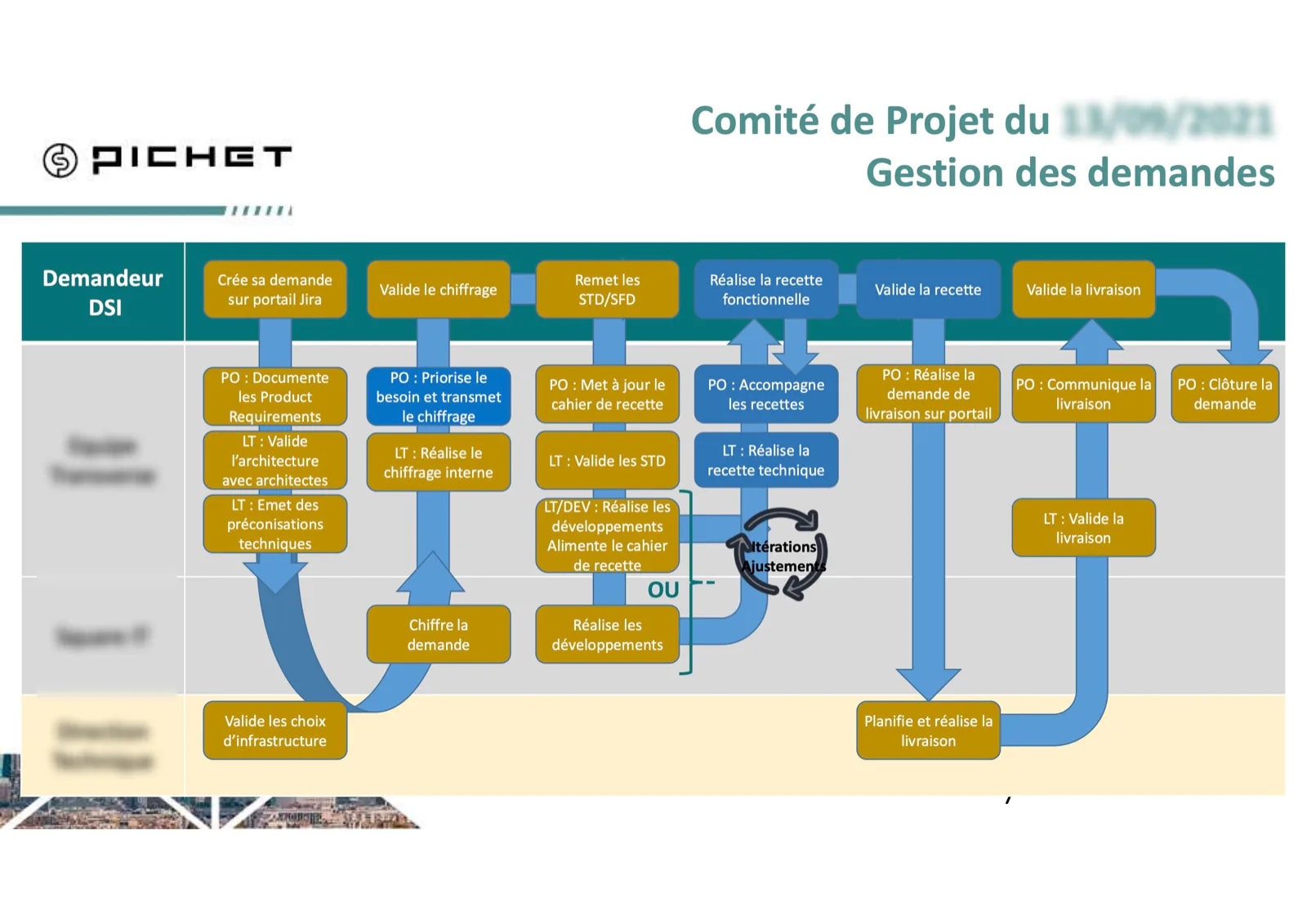
Groupe Pichet project committee workflow showing request management process across DSI, Product Owner, Lead Tech and infrastructure teams
Project committee - Request management workflow