Contact
Let's work together
MCR - Food Truck & Mobile Concept Platform

MCR - Food Truck & Mobile Concept Platform

Complete redesign of a WordPress site into a modern Next.js 16 + Payload CMS v3 platform for a French food truck manufacturer - 129K lines of code, 78 pages, 1,383 SEO contents, delivered in 41 days.

February - March 2026
41 days
Founder & CTO - Solo Developer
Next.js 16React 19TypeScriptPayload CMS v3PostgreSQL 16Tailwind CSS 4shadcn/uiStripeCloudflare TurnstileTerraformGitHub ActionsDockerDrizzle ORM4 AI APIs

Lines of Code

129,371

TypeScript (strict mode)

Pages

78

Next.js App Router

SEO Contents

1,383

Indexable contents

Database Tables

133

Including 46 versioning

Presentation

Project definition and scope

Mon Camion Resto (MCR) is the complete redesign of a French company's showcase website, specialized in designing, manufacturing, and customizing food trucks, trailers, converted containers, and mobile concepts for the food-service and events industry. The project replaces an outdated WordPress site with a modern application built on Next.js 16 and Payload CMS v3.

The company operates in a niche market at the crossroads of several sectors: vehicle bodywork and conversion, professional food-service, corporate events, and mobile concept rentals. It serves prestigious clients such as Futuroscope, Sodexo, IKEA, France TV, Elior, Charal, and Ralph Lauren, with 3 physical agencies across France (Bordeaux, Paris, Metz).

A significant part of the project involved developing numerous custom Payload CMS extensions - particularly tools dedicated to AI-powered content generation (articles, product descriptions, image creation) using 4 integrated providers (Claude, OpenAI, Gemini, Mistral). This custom development work on the CMS layer proved to be one of the most technically enriching aspects of the project.

Domain

Food-service vehicles, B2B events, custom vehicle conversions, mobile concept rentals

Target Users

B2B: event agencies, brands, food-service professionals - B2C: entrepreneurs starting a mobile food business

Functional Scope (7 Sections)
Expertise - Workshops & Skills
Concepts - Vehicles & Containers
Realizations - Project Portfolio
Pre-owned - Marketplace + Stripe
Rentals - B2B Event Fleet
Resources - Blog, Guides, Glossary, FAQ
Contact & Quotes - Multi-step Forms

Objectives, Context, Stakes & Risks

Strategic vision and constraints

Objectives
  • Completely redesign the WordPress site into a modern stack (Next.js + Payload CMS) with autonomous content management
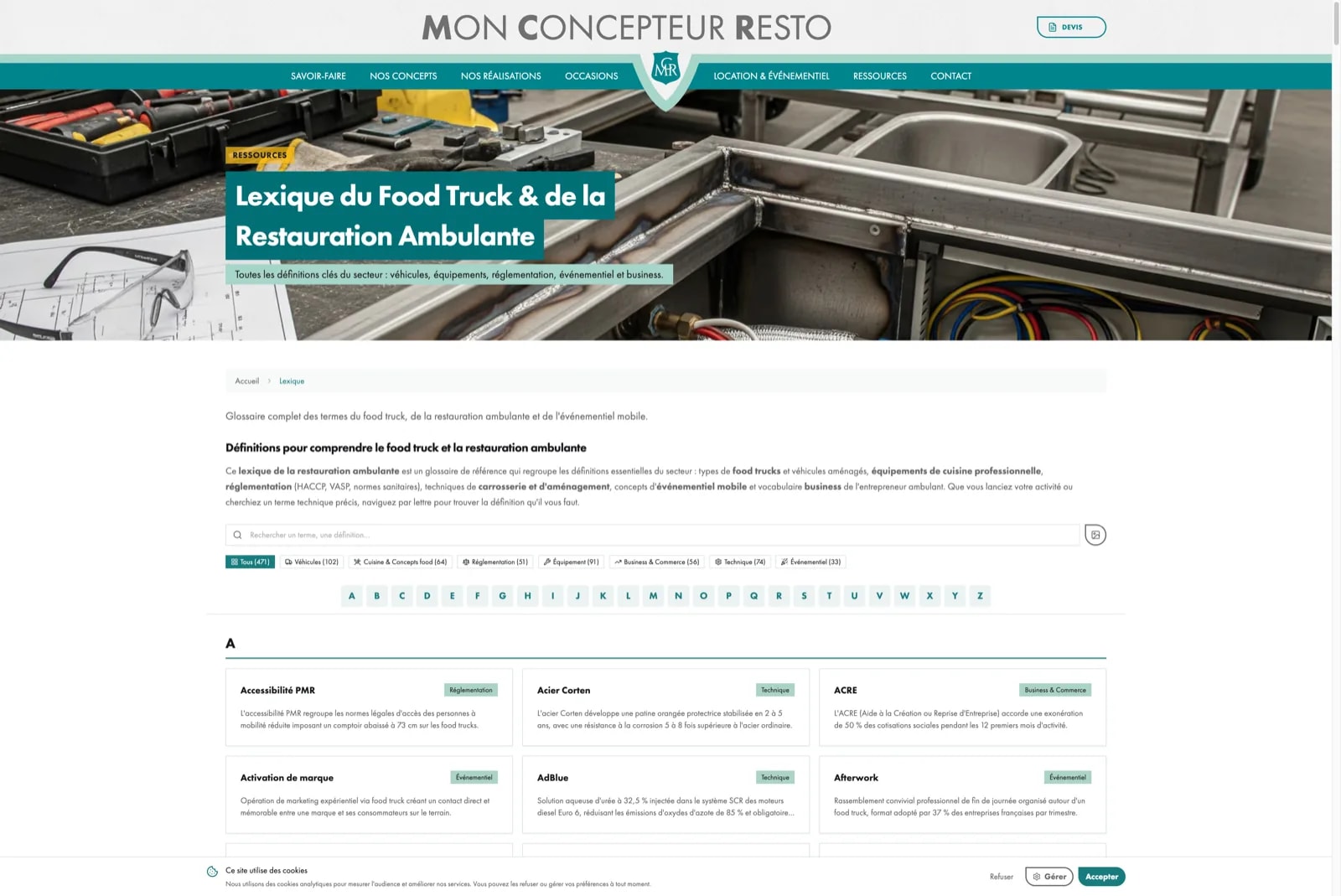
  • Multiply SEO visibility through a massive content strategy: 112 blog articles, 664 guides, 471 glossary terms
  • Professionalize brand image with a cohesive design system (shadcn/ui, 59 components) and quality visuals
  • Automate content generation via 4 AI APIs integration (Claude, OpenAI, Gemini, Mistral)
  • Structure the sales funnel with multi-step quote forms routed by agency and Stripe checkout for pre-owned vehicles
  • Industrialize deployment with complete CI/CD infrastructure (GitHub Actions, OVH VPS, 3 environments)
Context

The existing WordPress site suffered from broken navigation, poor SEO, outdated visuals, and generic contact forms. The company was transitioning from "Mon Camion Resto" to the "MCR" acronym while managing 6 domains (moncamionresto.com/fr, labeglaise.fr, location-foodtruck.fr, food-trucks.fr, mountain-egg.com). A database migration from WordPress (42 existing articles) was also required.

Business Stakes

SEO Visibility

The website is the primary acquisition channel - the redesign must maintain or improve existing rankings while massively creating new content

Lead Conversion

Quote and contact forms are the commercial backbone - every lead must be correctly routed to the right agency (Bordeaux, Paris, Metz)

Brand Image

The company works with clients like IKEA, France TV, and Ralph Lauren - the site must reflect this level of quality

Identified Risks

SEO Migration Risk

Potential loss of search rankings during migration - mitigated by implementing redirections and preserving legacy URLs via Nginx.

AI Content Quality

Massive volume of AI-generated content (664 guides, 471 terms) requiring human verification - a status system was implemented (not-verified, ai-verified, human-verified).

Infrastructure Constraints

Hosting on a single OVH VPS with 3 environments, limited to 8 GB RAM for the entire stack.

Multi-API Complexity

Integration of 4 different AI APIs (Anthropic, OpenAI, Google, Mistral) with varying billing models and rate limits.

The Steps - What I Did

Chronological phases and personal contributions

Project timeline - 41 days from first to last commit
Phase 1
Foundations
Feb 10-12
  • Next.js 16 + Payload CMS v3 + 56 shadcn/ui components setup in 3 days
  • Complete CMS data model: 15 collections, 4 globals, 24 content block types
  • All public pages + API routing + TypeScript strict configuration
  • Docker Compose for local PostgreSQL 16 + Mailpit email testing
Phase 2
Content & SEO
Feb 14-27
  • Complete design system with Futura PT typography, favicons, color tokens
  • Full SEO audit and PageSpeed optimizations (LCP, fonts, docs, bundles)
  • Editorial calendar + 4 AI APIs integration for content generation
  • 207 glossary terms generated and optimized for SEO
  • Admin panel with Payload CMS Lexical rich text editor
Phase 3
Infrastructure & Migration
Mar 2-9
  • Terraform DNS infrastructure for 6 domains via OVH API
  • WordPress migration: 42 articles imported via custom script (import-wp-adverts.ts)
  • Major site overhaul: new sections, 4-level navigation, client logos
  • 24 rental/event pages with detailed fleet catalog
Phase 4
CI/CD & Production
Mar 12-22
  • GitHub Actions pipeline: 5 jobs (lint, tests, build, E2E, auto-deploy)
  • Google Analytics 4 + GTM with custom event tracking
  • Stripe checkout for pre-owned vehicle marketplace
  • Cloudflare Turnstile anti-spam on all forms + admin login
  • AI-powered image generation for product pages
81 commits over 41 days - peak: 15 commits on March 13 (CI/CD marathon)

Actors & Interactions

Team, stakeholders, and collaboration dynamics

Development Team

The project was realized as a human + AI duo: one senior developer (Jose DA COSTA) assisted by AI agents (Claude Code, Gemini, ChatGPT). This model is documented through 5,328 lines of sequential prompts in the project's PROMPTS.md file.

Important nuance: While AI generated ~75% of code volume (mega-commits >10K insertions = 79% of total), the human value represents ~70% of the project's intellectual output - all architectural decisions, technical stack choices, data modeling (15 collections, 133 tables), infrastructure design, SEO strategy, client relationship, prompt engineering, and final validation.

ActorEstimated ContributionScope
Jose DA COSTA (human)~25% of code volume / ~70% of intellectual valueArchitecture, data modeling, infrastructure, SEO strategy, prompt engineering (5,328 lines), client relationship, quality validation
AI Assistants (Claude, Gemini, ChatGPT)~75% of code volume / ~30% of intellectual valueComponent generation, content creation (1,383 SEO items), page scaffolding, boilerplate, shadcn/ui setup
Code Volume Distribution (Lines Produced)
Intellectual & Decision-Making Value

Estimated acceleration factor: x3 to x4 - what would have taken 4-6 months was delivered in 41 days

External Stakeholders

Pierre-Olivier Paris

Company owner & CMS administrator - requirements via voice recordings transcribed by AI

Geoffroy

Commercial contact (Bordeaux agency) - email template coordination

Stripe

Payment integration for pre-owned vehicle marketplace

Cloudflare

Turnstile anti-spam protection for all forms

4 AI Providers

Anthropic, OpenAI, Google Gemini, Mistral - content generation and image creation

OVH

VPS hosting, SMTP email, domain DNS management

Results

Impact for myself and for the company

Codebase Metrics
SEO Content Distribution (1,383 Contents)
WordPress vs Next.js+Payload CMS
Design System Composition (203 Components)
Development Velocity (Commits per Week)
For Me - Skills Acquired & Reinforced

Technical Skills

  • Full-stack TypeScript/React/Next.js 16 with Payload CMS v3 at production scale (129K lines)
  • Custom Payload CMS extension development - built numerous bespoke admin tools, most of which are AI content generation utilities (text, descriptions, docs) leveraging 4 providers
  • Relational data modeling at scale - 133 PostgreSQL tables with Drizzle ORM
  • Multi-provider AI integration - 4 APIs for content generation and image creation
  • Infrastructure as Code - Terraform for DNS management across 6 domains
  • CI/CD pipeline design - GitHub Actions with 5 automated jobs across 3 environments
  • SEO architecture - 1,383 indexable contents with structured data and ISR
  • E-commerce integration - Stripe checkout, abandoned cart tracking, anti-spam protection

Functional & Human Skills

  • Requirements analysis from voice recordings - transcribed and structured by AI
  • SEO content strategy - architecture, internal linking, keyword coverage
  • AI-assisted development methodology - prompt engineering at scale (5,328 lines)
  • Autonomous project management - prioritization, rapid iterations, solo delivery
  • WordPress to headless CMS migration - data extraction and transformation
For the Company - Business Impact

1,383

SEO contents

Indexable pages created (vs. 42 on WordPress)

78

Pages

Complete site with 7 layouts and 4-level navigation

15

CMS collections

Autonomous content management via Payload CMS admin

3

Environments

Test (auto-deploy), Staging, Production

Project Aftermath

What happened after delivery and current state

Immediate Future: The platform was deployed to a production environment (production.moncamionresto.com) with two additional environments (test, staging). The test environment is auto-deployed on every push to main via GitHub Actions CI/CD. The CMS admin is accessible and operational for the team.

Medium-Term: The site is live under a temporary subdomain while the final DNS migration from the old WordPress site is pending. The massive SEO content (1,383 items) needs progressive human verification - the verification status system (not-verified / ai-verified / human-verified) is already in place. Business-critical collections (realizations, pre-owned vehicles, rental fleet) are structured and ready to be populated with real data.

Current State: The platform represents a 33x increase in indexable content compared to the original WordPress site (1,383 vs. 42 items). The infrastructure is production-ready with SSL, automated backups, CI/CD, and monitoring. The n8n automation platform is deployed for workflow automation.

Critical Reflection

Retrospective analysis and lessons learned

Strengths
  • Exceptional development velocity

    129,000+ lines of code in 41 days - an average of 3,000+ lines/day enabled by AI-assisted development. The combination of Claude Code and Gemini as productivity tools multiplied output by an estimated x3 to x4.

  • Modern and coherent tech stack

    Next.js 16 + React 19 + Payload CMS v3 + TypeScript strict - the CMS integrated directly into Next.js eliminates microservice complexity while maximizing developer productivity.

  • Ambitious SEO strategy, well executed

    1,383 contents created with a built-in verification system (not-verified / ai-verified / human-verified) enabling progressive quality improvement. The glossary and guides create dense internal linking.

  • Professional infrastructure

    Terraform for DNS, GitHub Actions CI/CD with 5 jobs, 3 distinct environments, robust deployment scripts with production safety confirmations.

  • Complete design system

    59 shadcn/ui + 147 custom components + 24 content block types - offering editorial flexibility while maintaining visual consistency.

Areas for Improvement
  • Insufficient test coverage

    Only 8 test files (6 unit + 2 E2E) for 129,000 lines of code. Critical API routes (contact, quotes, Stripe payments) deserve exhaustive testing.

  • Unverified AI content

    The massive volume of AI-generated content (664 guides, 471 terms) represents a quality risk. The verification system exists but human review remains to be done.

  • Single-branch workflow

    All development on main without feature branches - acceptable for a solo developer but limits scalability with a team.

  • No semantic versioning

    No git tags or releases, making it difficult to track deployed versions in production.

What I Would Do Differently
  • Tests from the start - even in solo mode, testing critical API routes (contact, quotes, Stripe payment) would have secured core business functionality
  • Content strategy in batches - rather than 664 guides at once, a batch approach with human validation between each would have guaranteed quality
  • Feature flags - a feature flag system would have enabled progressive production deployments without risk
Lasting Lessons

AI as a force multiplier

One senior developer assisted by AI can produce a 129K-line site in 41 days. The key is using AI for volume (content generation, component scaffolding) while keeping human control over architecture and structural decisions.

Integrated headless CMS > decoupled CMS

Integrating Payload CMS directly into Next.js eliminates network latency, simplifies deployment, and enables end-to-end TypeScript typing - far more productive than a decoupled architecture for this project size.

Infrastructure as Code from day 1

Terraform for DNS and structured deployment scripts make the infrastructure reproducible and documented - an investment that pays off immediately.

SEO content is a strategic asset

1,383 indexable contents represent a lasting competitive advantage. Even if individual quality is improvable, the volume and topical coverage create a structural advantage in search rankings.

Architecture

Related journey

Professional experience linked to this achievement

Skills applied

Technical and soft skills applied

Image gallery

Project screenshots and visuals

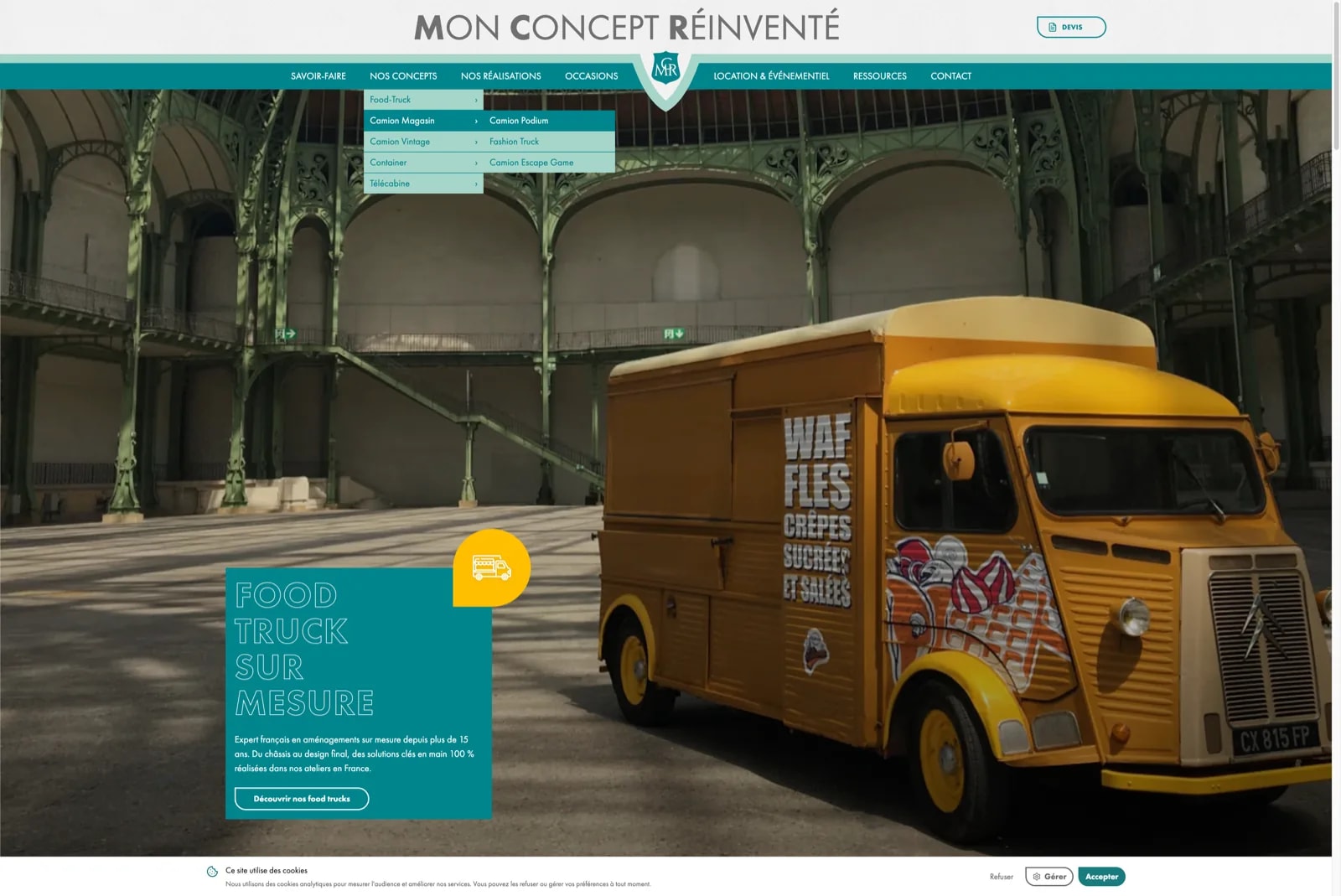
Mon Camion Resto homepage with vintage food truck, custom design services and navigation menu
Homepage - Food truck custom design services
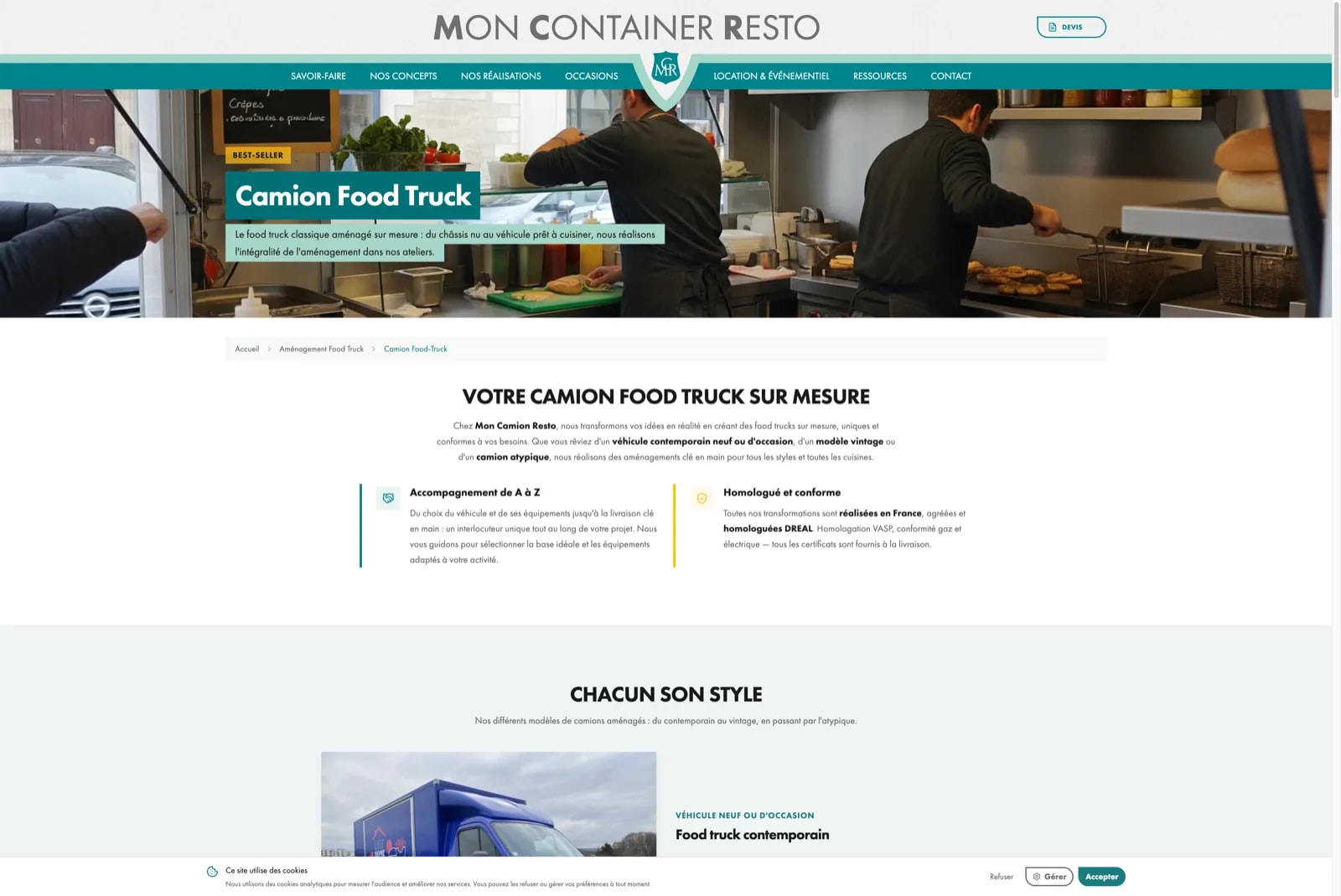
Food truck customization page showing bespoke vehicle fitting, standards compliance and style options
Customization - Bespoke food truck fitting
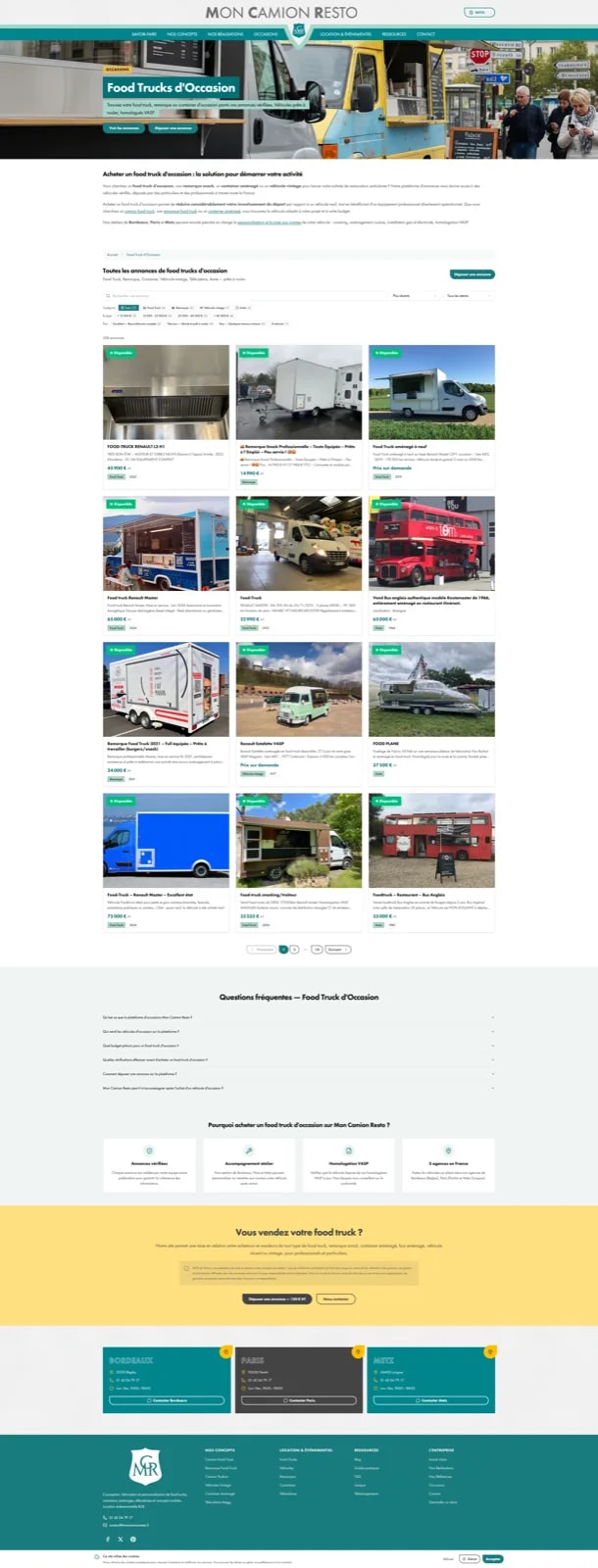
Used food trucks marketplace with grid of refurbished vehicles for sale including various models and styles
Marketplace - Used and refurbished food trucks
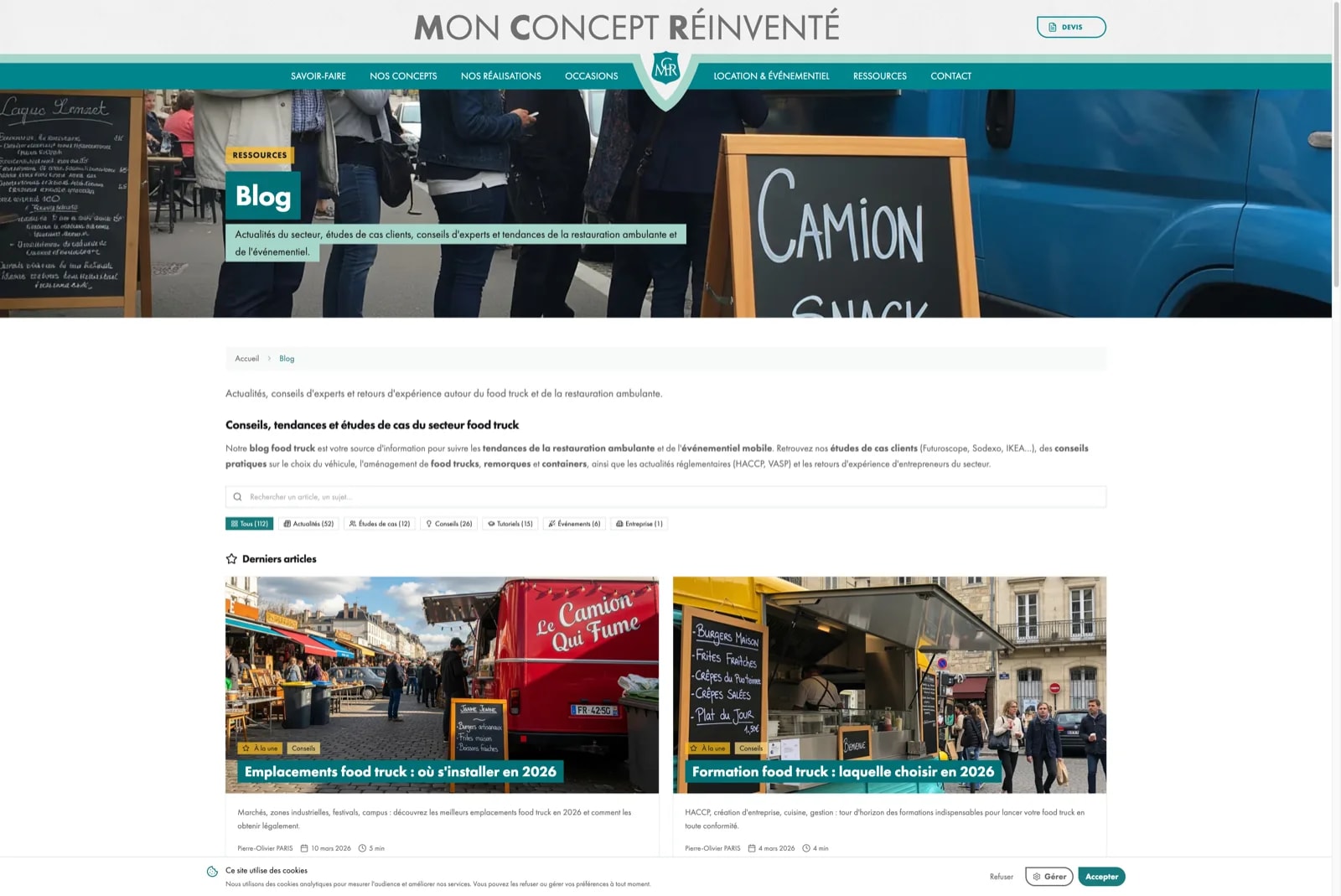
Mon Camion Resto blog with articles on food truck locations, training and industry trends
Blog - Industry articles and case studies
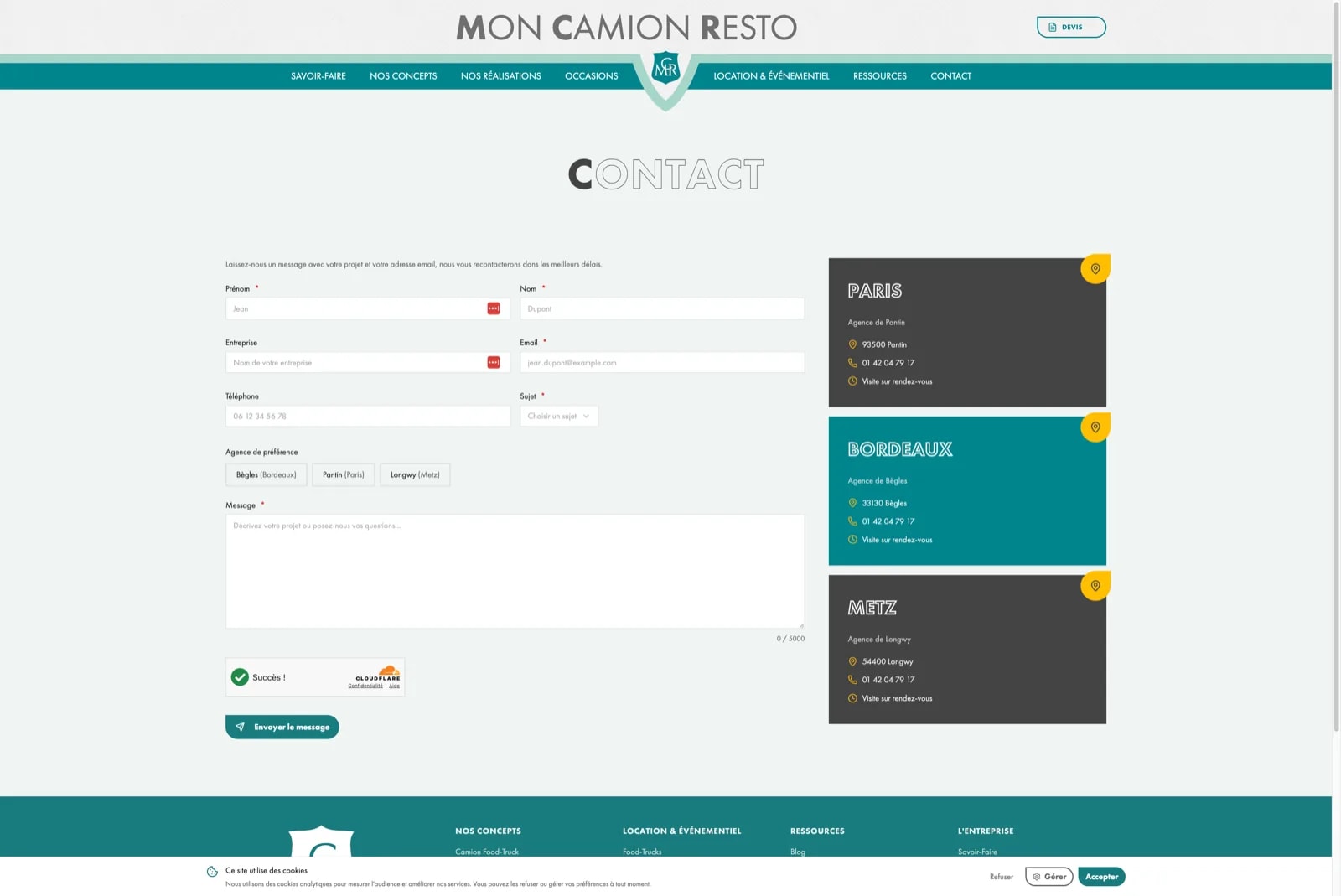
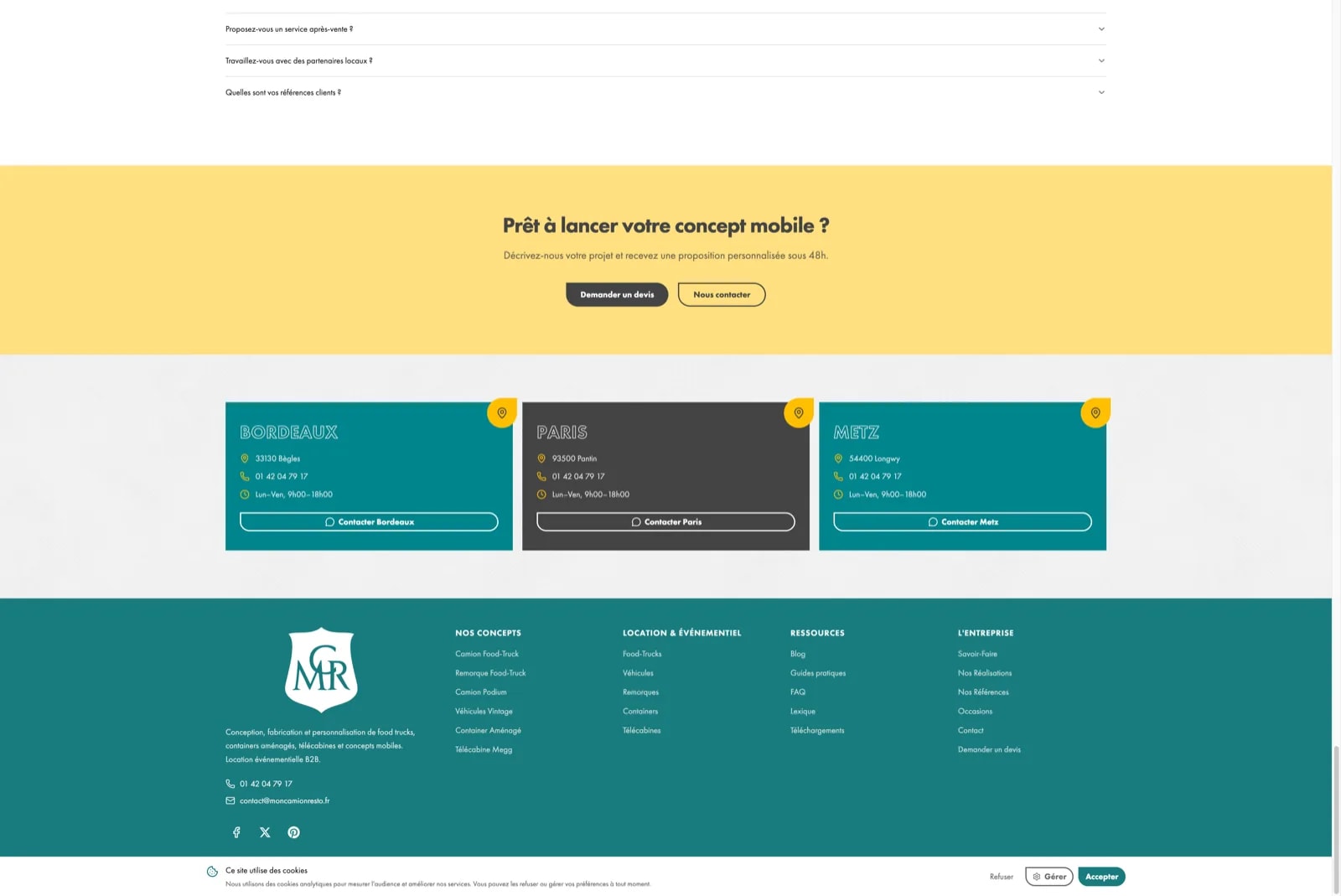
Contact page with form, Paris, Bordeaux and Metz office locations and phone numbers
Contact - Multi-city offices (Paris, Bordeaux, Metz)
Food truck glossary and lexicon page with alphabetical definitions for mobile catering industry terms
Glossary - Food truck industry lexicon A-Z
Footer with call-to-action for mobile concept launch, quote request and multi-city contact cards
Footer - CTA and multi-city contact