tailwindcss-obfuscator
Open Source CSS Obfuscation Tool for Tailwind CSS v3 & v4
Project Overview
Protecting CSS intellectual property in the Tailwind ecosystem
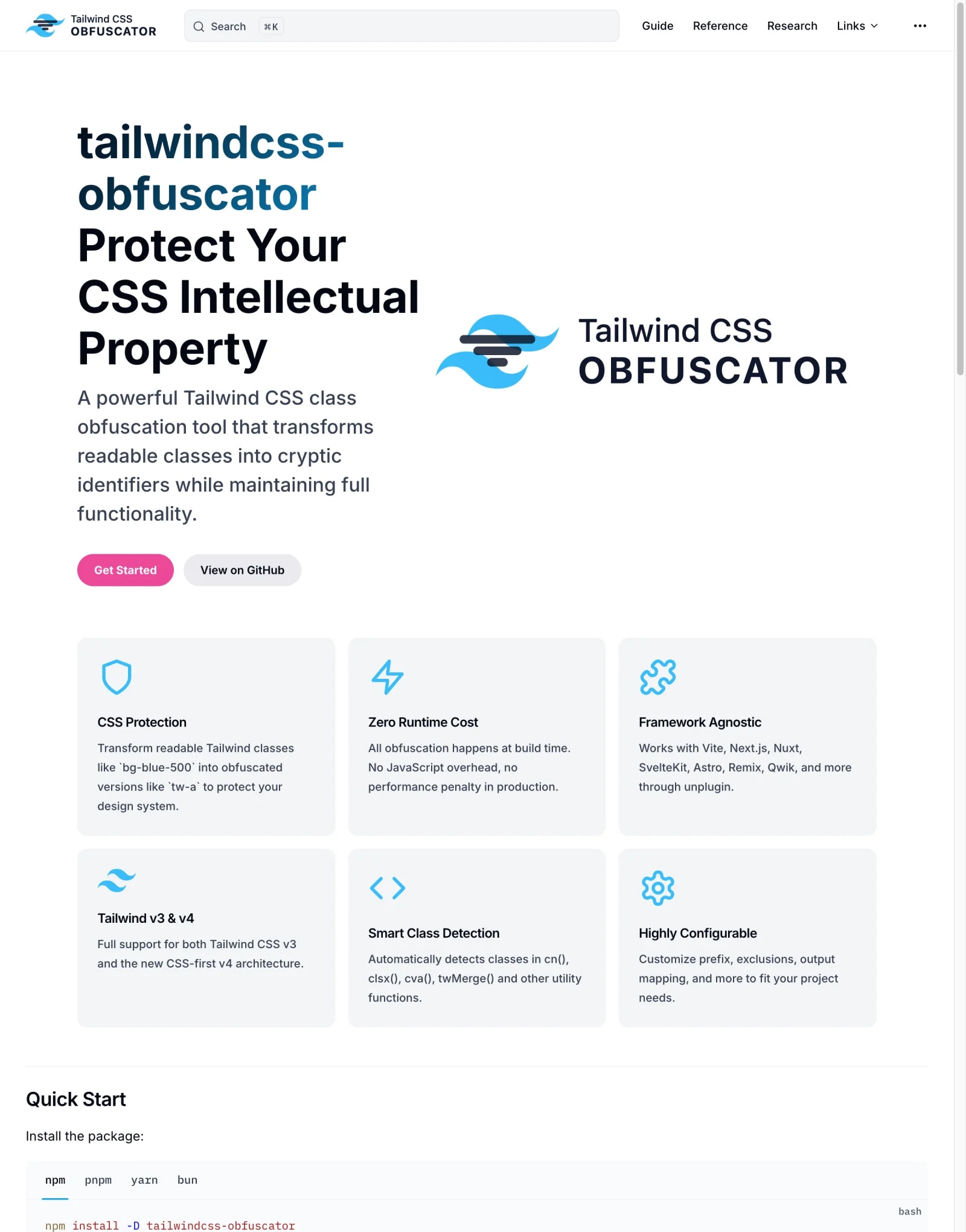
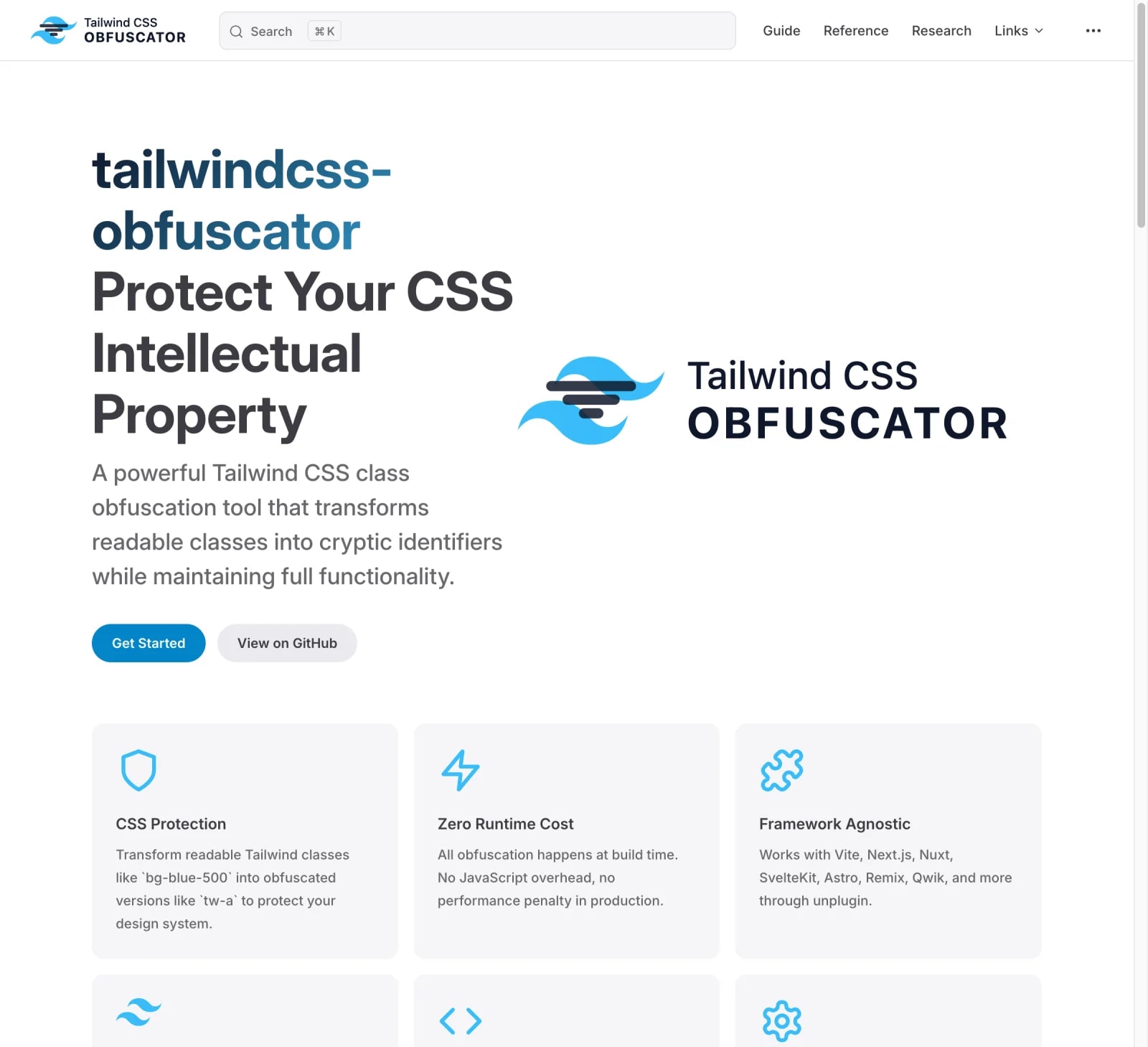
An open source npm package that obfuscates CSS class names generated by Tailwind CSS, transforming readable names like `bg-blue-500` into short opaque identifiers at build time.
The only existing competitor relies on patching Tailwind internals - an approach that broke with Tailwind v4 (Rust/Oxide rewrite). There was no v4-compatible solution on the market.
tailwindcss-obfuscator is an open source npm package that obfuscates (mangles) CSS class names generated by Tailwind CSS. It transforms readable class names like `bg-blue-500 hover:bg-blue-700` into short, opaque identifiers like `tw-a tw-b` at build time.
The tool operates through a three-phase pipeline: extraction of Tailwind classes from source files (HTML, JSX, TSX, Vue, Svelte, Astro, Qwik, CSS), deterministic or random mapping generation, and systematic replacement in compiled CSS and templates.
The project fills a gap in the Tailwind CSS ecosystem. The only existing competitor (unplugin-tailwindcss-mangle) relies on patching Tailwind internals - an approach that broke with Tailwind v4 (rewritten in Rust/Oxide). tailwindcss-obfuscator takes a different approach based on static analysis, compatible with both major versions.
Static Analysis - Framework-agnostic class extraction from HTML, JSX, Vue SFC, Svelte, Astro, Qwik and CSS files
Dual Parsing - Two transformation modes: fast regex for simple cases and precise AST (Abstract Syntax Tree) via Babel + PostCSS for complex scenarios
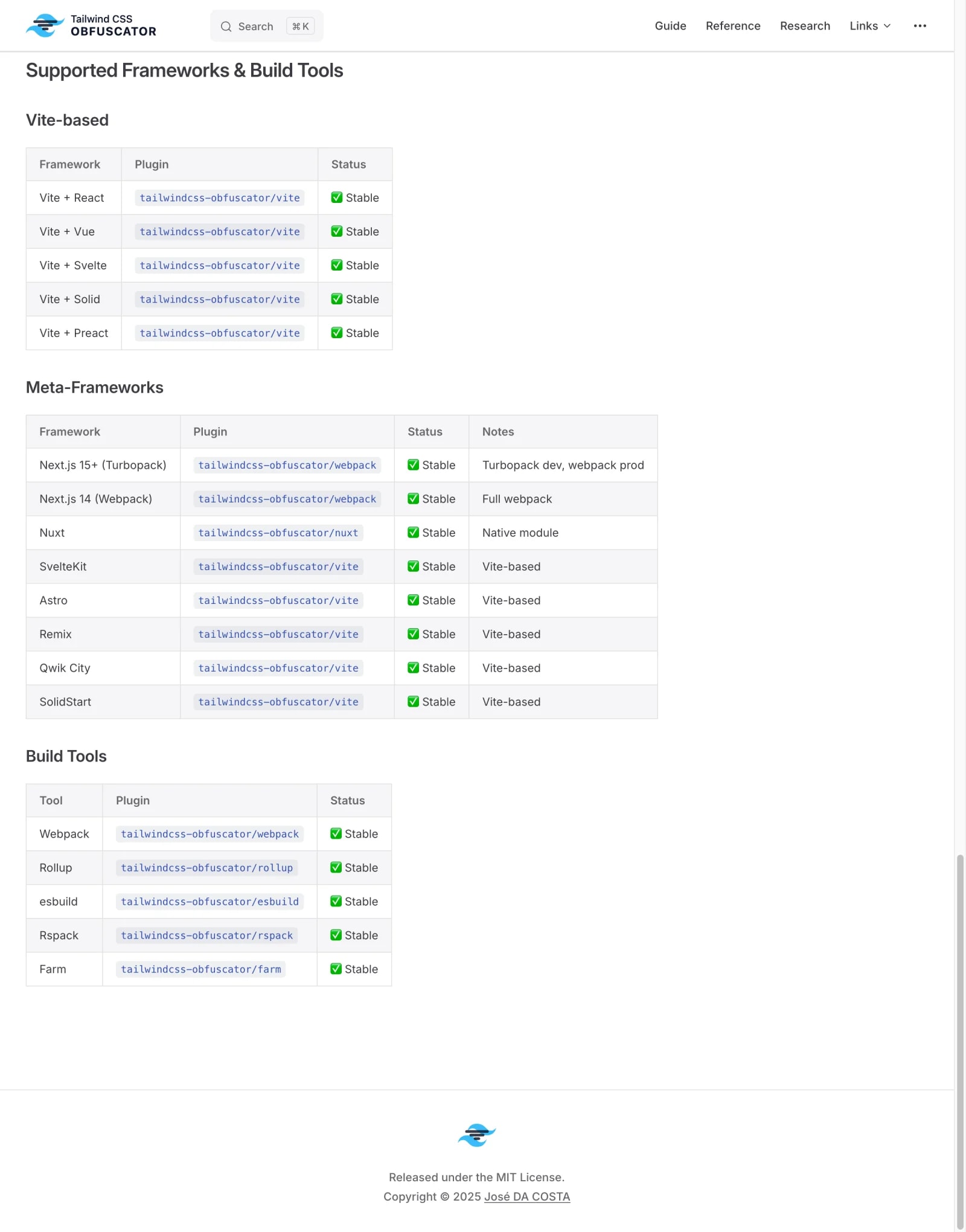
Universal Plugins - 5 bundler plugins (Vite, Webpack, Rollup, esbuild, Nuxt module) sharing the same core engine
Tailwind v3 & v4 - First obfuscation tool compatible with Tailwind v4 (Rust/Oxide engine) - auto-detection of version
Objectives, Context & Risks
Strategic positioning in a niche with zero v4-compatible solutions
Opaque class names
CSS IP Protection
-75% on example
Bundle Size Reduction
10 frameworks
Framework Coverage
Build-time only
Zero Runtime
Tailwind CSS v4 (released late 2024) introduced a major breaking change: the engine was rewritten in Rust (Oxide), dropping `tailwind.config.js` in favor of CSS-first configuration. This made the only competitor tailwindcss-mangle incompatible with v4, as it relied on patching Tailwind JavaScript internals. The window of opportunity was clear: be the first v4-compatible obfuscation tool.
The tool value is directly proportional to framework coverage - every unsupported framework means lost users. The obfuscation must never break rendering: any undetected class produces a silent visual bug, the worst kind of failure in CSS tooling.
False Negative Extraction
A missed class in HTML that exists in CSS produces a silent visual bug. Mitigated by 295 tests, 10 test apps, and specialized extractors per framework.
Tailwind Version Incompatibility
Future Tailwind updates could break extraction patterns. Mitigated by auto-detection and modular architecture.
Dynamic Classes Limitation
Classes built at runtime cannot be statically extracted. Documented as an explicit constraint with "static classes only" guidance.
Third-party Library Conflicts
Utility libraries like CVA, clsx, twMerge could break. Mitigated by explicit support for cn(), clsx(), cva(), twMerge(), tv().
Implementation Phases
From ecosystem research to npm publication in 6 weeks
- Analyzed the ecosystem: detailed study of tailwindcss-mangle and tailwindcss-patch limitations
- Reverse engineered competitor repositories (sonofmagic/tailwindcss-mangle, tailwindlabs/tailwindcss)
- Catalogued Tailwind v4 changes (2,500+ lines of analysis) and their impact on obfuscation
- Created a 3-phase implementation roadmap prioritized by criticality
- Built 5 specialized extractors (~1,400 lines): HTML, JSX/TSX, Vue SFC, Svelte, CSS with 100+ Tailwind variant detection
- Built 6 transformers (~1,500 lines): dual mode - regex (fast) and AST (Abstract Syntax Tree) via Babel/PostCSS (precise)
- Implemented core engine (~2,400 lines): shared context, persistent cache, deterministic and cryptographic random name generation
- Added source map support via magic-string for accurate debugging
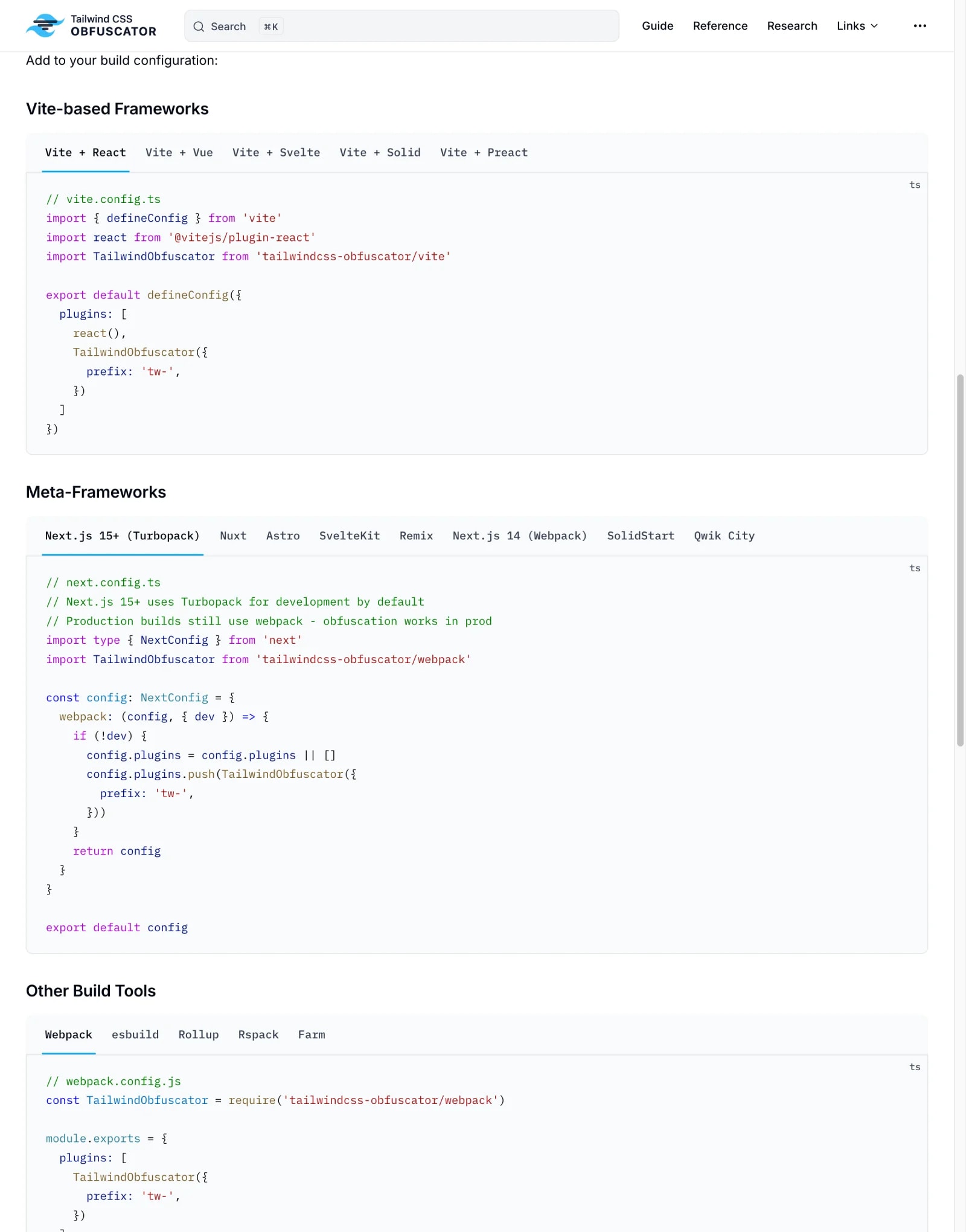
- Vite plugin: hooks on configResolved, buildStart, transform, transformIndexHtml, generateBundle, closeBundle
- Webpack plugin: hooks on beforeCompile, compilation, processAssets, afterEmit
- Rollup plugin: hooks on buildStart, transform, generateBundle, closeBundle
- esbuild plugin: hooks on onStart, onLoad, onEnd
- Nuxt module: auto-detects Vite/Webpack, loads config, integrates Nuxt lifecycle
- Created 21 test applications across 10 frameworks and 2 Tailwind versions
- Wrote 295 test cases in 92 describe blocks covering all extractors, transformers, and edge cases
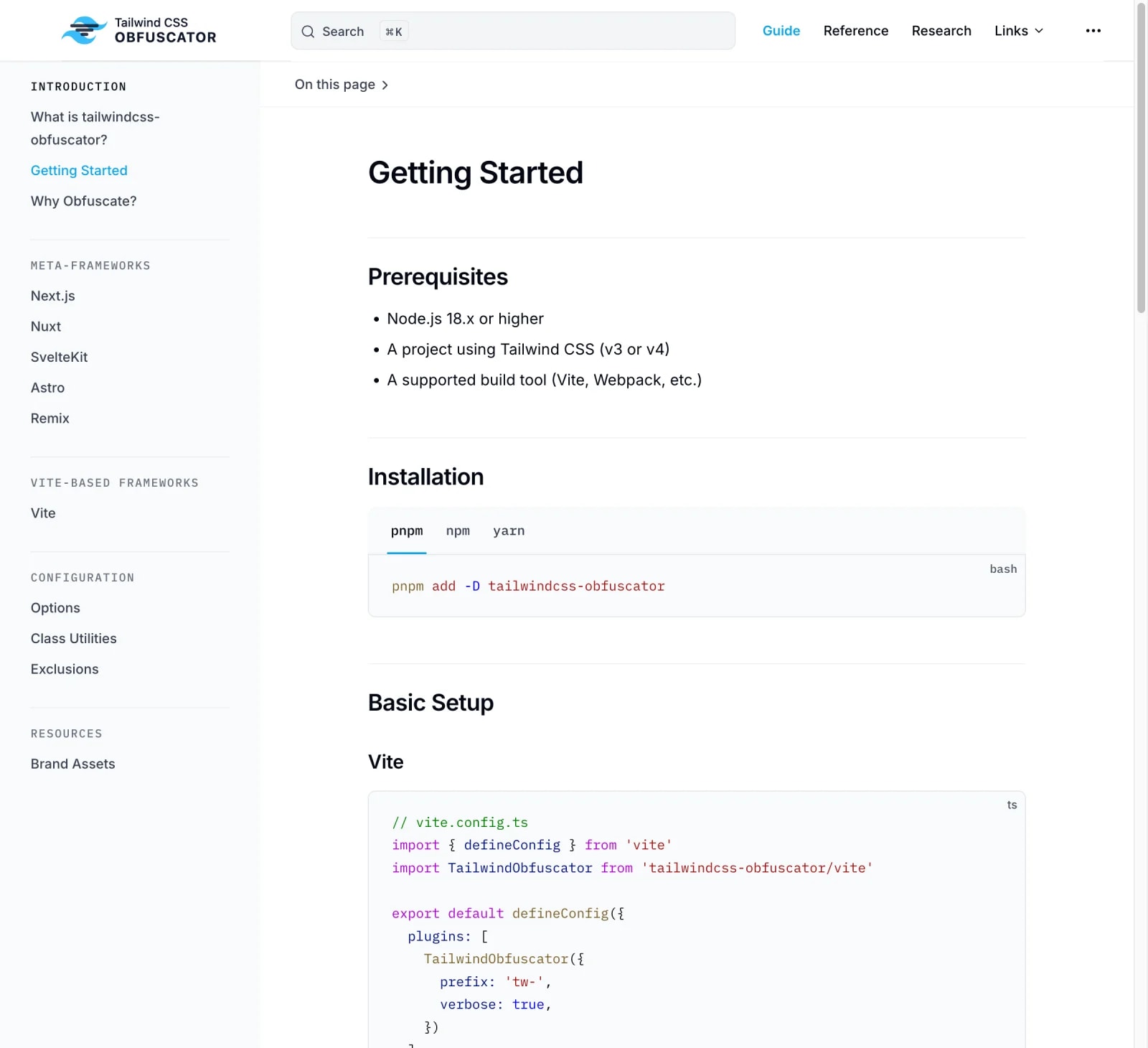
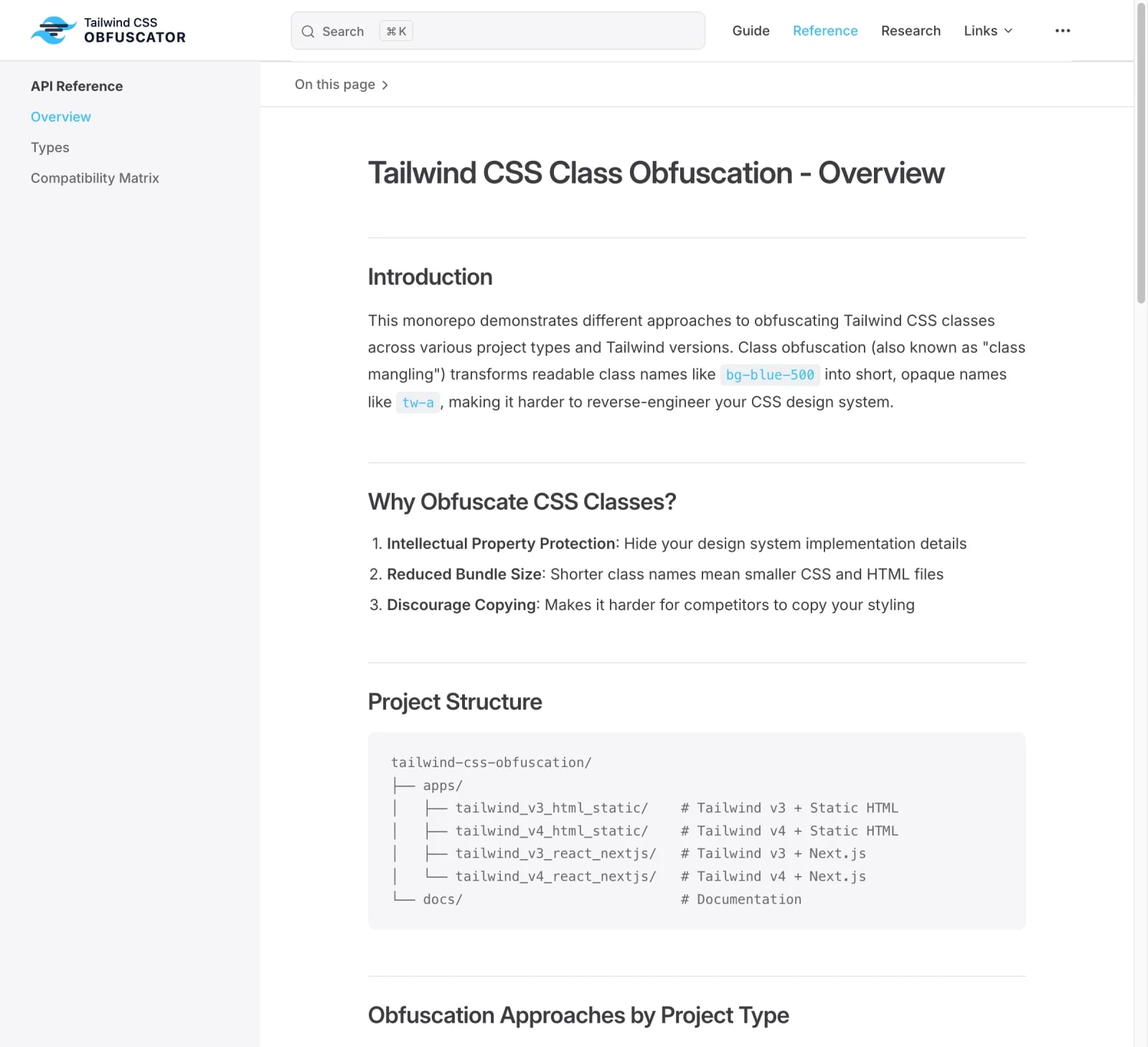
- Built a complete VitePress documentation site (34 Markdown files, 10,400 lines)
- Designed brand assets: custom SVG logos (light/dark), icons, and 840 lines of custom CSS
- Published to npm registry as tailwindcss-obfuscator v1.0.0
- Configured package exports for ESM + CJS + DTS via tsup
- Created professional README with badges, quick start, and compatibility matrix
Actors & Interactions
Human + AI collaboration producing 82K lines of code
This project was built as a Human + AI pair. Jose DA COSTA acted as Product Owner, Tech Lead, and QA, while Claude Code (Anthropic AI assistant) handled all code implementation, tests, and documentation.
I used AI to accelerate code production, but I made every strategic decision myself: market positioning, architecture choices, scope priorities, and quality validation. Without that direction, the AI would have produced technically correct code solving the wrong problem.
- Product vision: identified the market gap for a v4-compatible obfuscator
- Architecture decisions: chose TurboRepo monorepo, pnpm workspaces, and static analysis approach
- Strategic pivots: abandoned tailwindcss-patch in favor of a custom package
- Creative direction: chose colors, logos, sidebar organization, documentation structure
- Quality control: verified every page visually, ran manual tests, requested corrections
- Scope management: added frameworks progressively (SvelteKit, Astro, Qwik, Solid.js, Remix)
- Source code: wrote all 25 TypeScript modules (7,401 lines)
- Tests: created all 295 Vitest test cases (4,013 lines)
- Documentation: authored all 34 Markdown files (10,404 lines)
- Test applications: built and configured 21 apps across 10 frameworks
- Design: created SVG logos, VitePress theme (840 lines CSS)
- Research: ecosystem analysis, competitor reverse engineering (3,000 lines)
Results & Metrics
First Tailwind v4 obfuscation tool on the market
Source Lines
7,401
Package TypeScript source code
Test Cases
295
In 92 describe blocks
Documentation
10,404
Lines of documentation (140% ratio vs code)
Frameworks
10
Frontend frameworks supported
Bundlers
4
Vite, Webpack, Rollup, esbuild
Test Apps
21
Real-world test applications
This project deepened my expertise in AST (Abstract Syntax Tree) manipulation (Babel parser/traverse, PostCSS selector parsing), build tool plugin architecture across 4 bundlers, and the npm publishing pipeline. Working with Tailwind v4 Oxide internals provided valuable insight into Rust-based JavaScript tooling. The AI collaboration pattern (100 prompts producing 82K lines) validated a workflow I now apply to all projects.
First and only Tailwind v4-compatible obfuscation tool available on npm. Published as open source, impact measurable via npm download counts. Fills a gap left by the v3-only competitor, giving the community a production-ready solution for CSS intellectual property protection.
Technical Architecture
What Came After
From publication to ongoing maintenance
Published v1.0.0 to npm with professional README, compatibility matrix, and VitePress documentation site. The package was immediately usable via `npm install tailwindcss-obfuscator` with zero-config defaults.
The project is in maintenance mode, monitoring Tailwind CSS updates for potential breaking changes. The modular architecture (separate extractors, transformers, plugins) makes adding support for new frameworks or bundlers straightforward.
Published on npm (v1.0.0), source on GitHub. The static analysis approach has proven more resilient than the competitor patch-based approach, validating the initial architectural decision.
Critical Reflection
Honest retrospective on decisions and trade-offs
- Static analysis approach - independent from Tailwind internals
- 10 frameworks x 2 Tailwind versions, 21 test apps for non-regression
- Dual parsing: fast regex + precise AST (Abstract Syntax Tree) via Babel, PostCSS
- Zero TODO/FIXME, strict TypeScript, clean architecture
- 140% docs-to-code ratio (10,400 lines of documentation)
- No CI/CD pipeline (GitHub Actions) for automated testing
- No E2E tests (unit tests only)
- No git tags/releases for version tracking
- Only 3 bootstrap commits - no granular git history
- 8 research "lab-*" apps could be archived
- AI without verification is useless: code agents are probabilistic systems: their output varies from one run to the next, and without systematic verification (automated tests, linting, manual review), no quality control is possible. Generating code is the easy part. The real challenge is knowing what to build, how to verify it, and where to place the right guardrails. That requires concrète engineering experience, hours of research, and hundreds of reasoned technical decisions before even launching an agent. "AI multiplies the value of experience, not ignorance. Seniors exploit AI, juniors use it."
- Real test applications: rather than testing in isolation, building real apps that use the tool under production conditions is the best way to validate compatibility.
- Dual-mode parsing: offering two precision levels with explicit trade-offs is a reusable pattern for any code transformation tool.
- Documentation as investment: 10,400 lines of documentation facilitate adoption and reduce support cost - applicable to any open source project.
Related journey
Professional experience linked to this achievement

Skills applied
Technical and soft skills applied
Image gallery
Project screenshots and visuals