Technical Project Manager · Co-founder · Early-Stage Startup
AdsPower
Bootstrapped startup with no external funding. Team of 1 to 5 people depending on project phases.
Multiple hats worn simultaneously, primarily as Technical Project Manager: product vision, architecture, development, recruitment, project management.
Race to MVP before cash depletion, fast decisions with incomplete information, constant iterations.
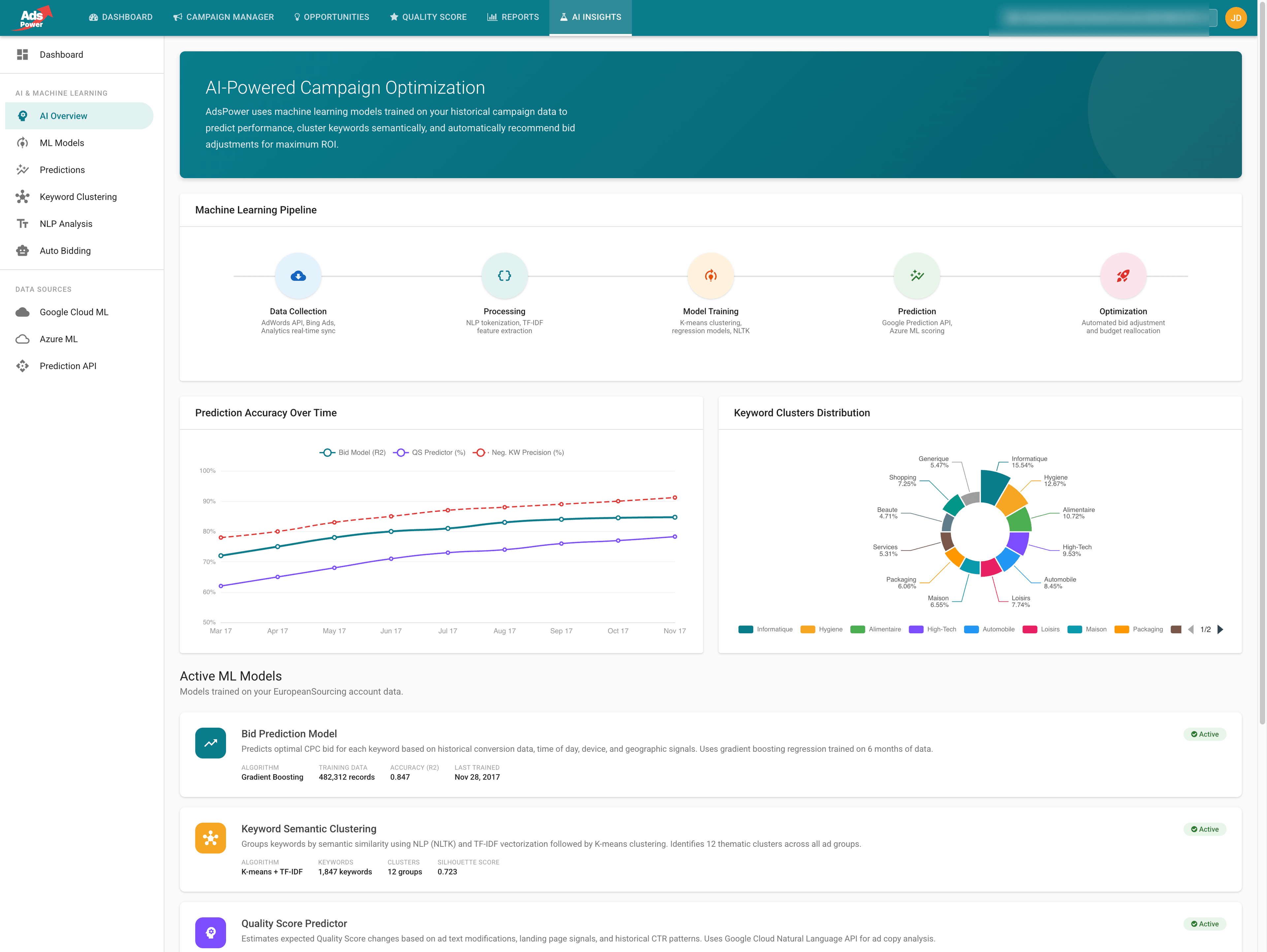
Early-stage startup building a SaaS platform for AI-driven ad campaign optimization. The product used machine learning to classify user behaviors, predict conversion probability, and automatically optimize bids based on conversion success rates.
As Technical Project Manager, led the project end-to-end: functional and technical scoping, planning, coordinating a team of 4 freelancers, and tracking MVP delivery.
As Technical Project Manager and co-founder, I led the project from conception to delivery. My primary role was technical scoping and coordination: defining functional scope, planning sprints, making technical tradeoffs, and tracking quality and deadlines.
I recruited and managed a team of 4 freelance developers, running Scrum ceremonies: task assignment, code review, sprint facilitation and unblocking technical issues.
Alongside project management, I contributed directly to code on critical modules (backend architecture, ad platform API integrations, ML pipelines) - a hybrid management + hands-on positioning typical of early-stage startups.
- Technical scoping and specification writing: translating business needs into functional and technical specs, requirements document, data model (Skipper ORM Designer), competitive analysis (Optmyzr, Dolead)
- Delivery planning and tracking: product roadmap definition, sprint breakdown, workload estimation, progress tracking and dependency management across modules (backend, frontend, ML, APIs)
- Risk and external dependency management: monitoring AdWords API quotas, anticipating breaking changes, contingency planning for third-party services (Google Prediction API, Azure ML), unblocking cross-module technical issues
- AI R&D leadership: defining ML objectives, overseeing construction of classification pipelines (Azure ML, NLTK, TF-IDF, k-means) to classify search intent and optimize bids based on conversion rates
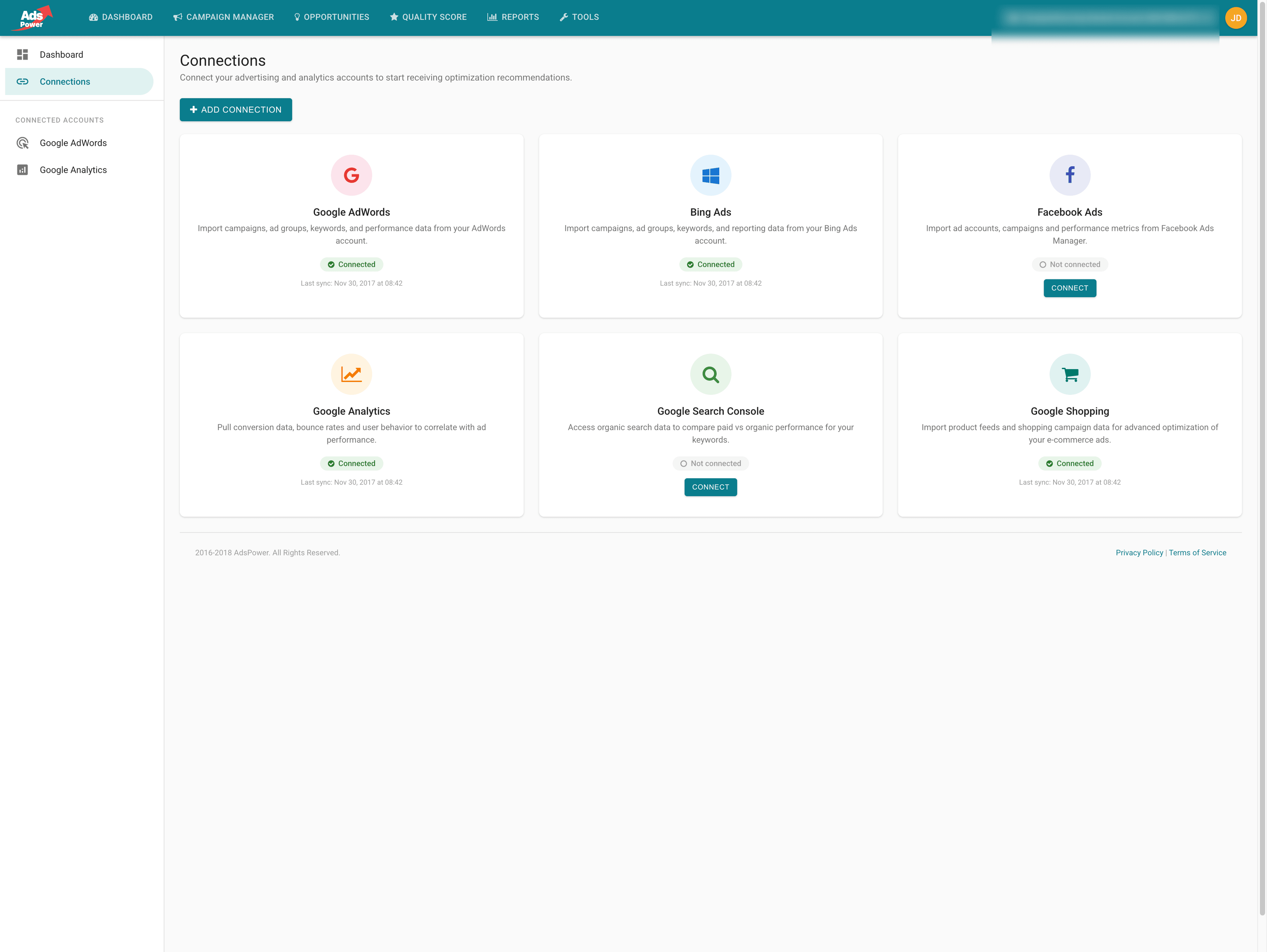
- Ad platform API integration (Google AdWords, Bing Ads, Facebook Ads): scoping technical constraints, coordinating development of import/export and reporting connectors
- Technical architecture design: multi-bundle Symfony backend, Angular SPA frontend, RESTful API with JWT, ML pipelines deployed as REST services
- CI/CD pipeline setup (GitLab CI): automated staging deployment, manual production release, defining quality gates (tests, ML coverage)
- Full project documentation: requirements document, detailed technical specifications, functional specs (back-office, private front-office, public front-office), data model, market study
Recruited 4 freelance developers (ReactJS, Angular specialists) from the Bordeaux area, identified through GitHub search. Each freelancer had a defined scope (frontend modules, API integrations, testing) with clear deliverables per sprint.
- Deliver a working MVP within the time and budget constraints of a bootstrapped startup
- Validate the AI-driven optimization approach with real advertising data before cash depletion
- Build a scalable architecture supporting multiple advertising platforms (Google, Bing, Facebook)
- Recruit, structure and coordinate a team of 4 freelancers around Agile Scrum practices
Agile Methodology
Work organized using Scrum adapted to the startup context: 2-week sprints managed on Trello, daily remote stand-ups, sprint reviews with product demos, retrospectives to adjust the process. Backlog prioritized by business impact and technical feasibility - the rule: if a feature doesn't bring us closer to MVP, it doesn't enter the sprint.
Prioritization & MVP Scope
Scope decisions guided by a simple principle: ship the minimum that validates the business hypothesis. Every candidate feature went through a 3-question filter - does it help sign a first customer? Does it reduce a blocking technical risk? Can it wait for v2? This discipline allowed us to deliver 3 major backend versions in under a year.
Technical Tradeoffs
Constant tradeoffs between speed and quality. Chose a Symfony multi-bundle architecture over a monolith - slower to set up but essential for distributing work across freelancers. Conversely, deliberately chose Angular Material with pre-built Syncfusion components over custom design - saving 2 months of frontend development.
Tracking KPIs
Tracked sprint velocity (story points delivered), sprint completion rate, critical bugs in staging, automated test coverage on ML modules, and time-to-deploy (from feature branch to accessible staging).
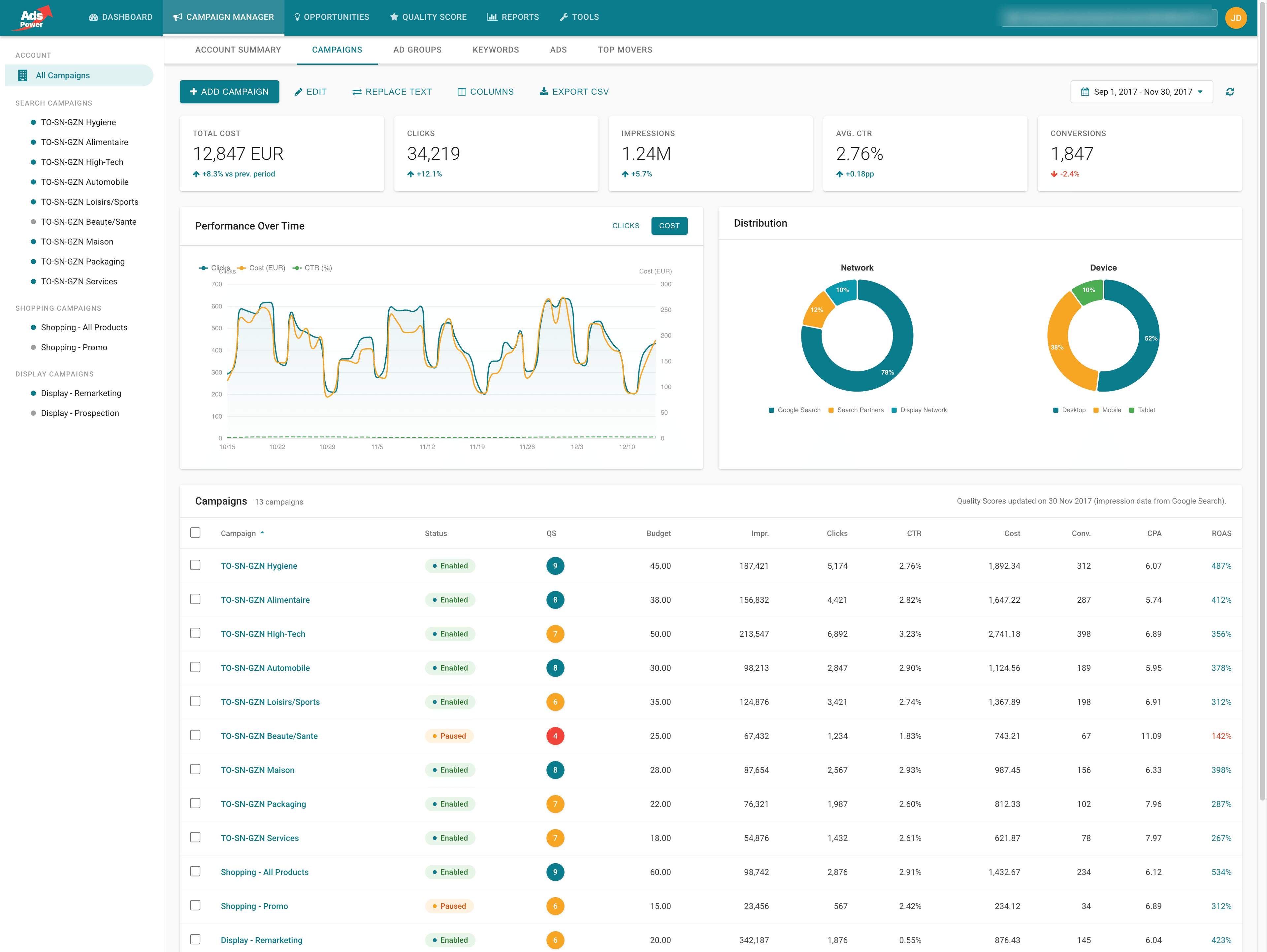
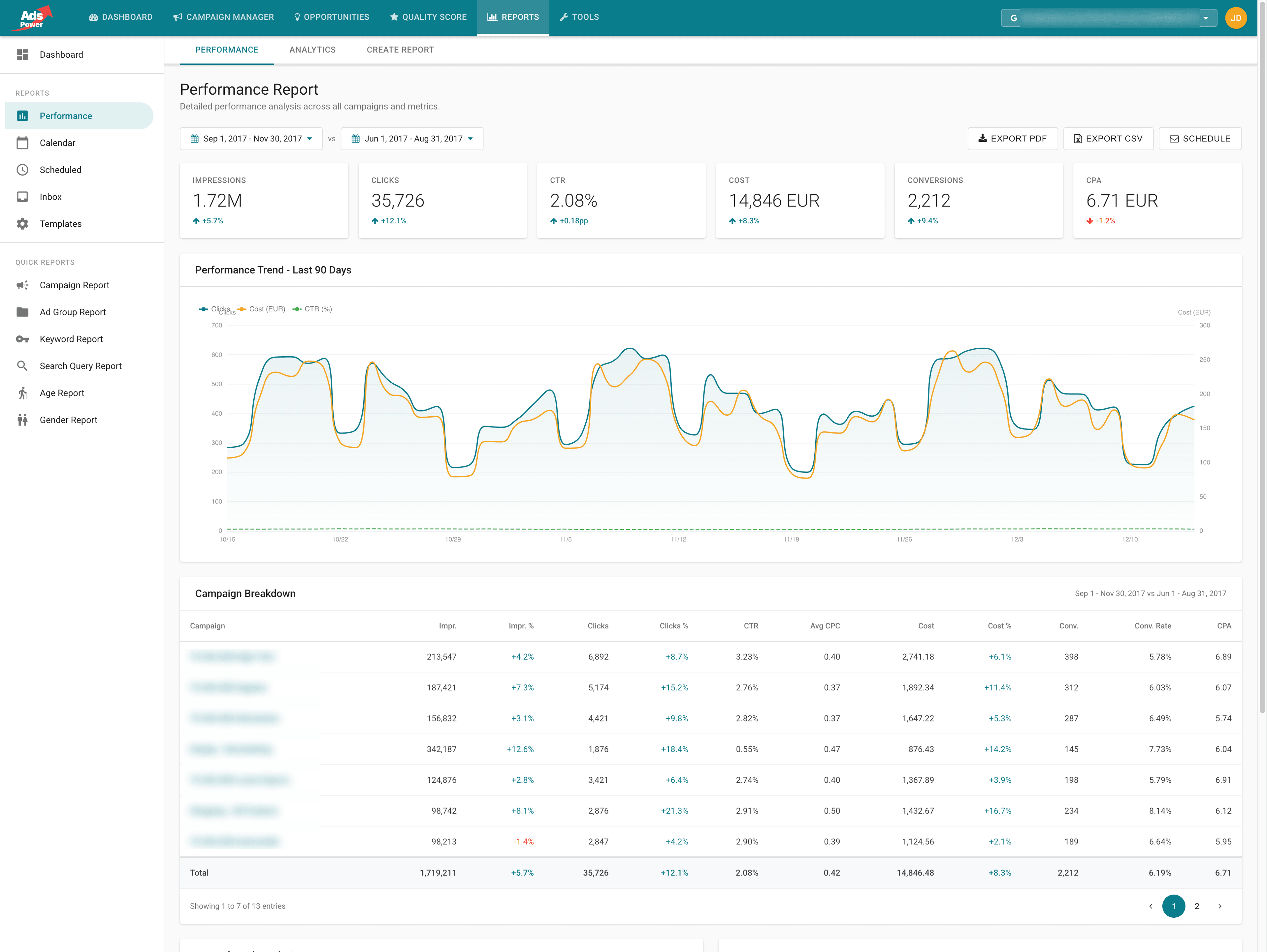
AdsPower was a SaaS platform built around machine learning to optimize online advertising campaigns (Google AdWords, Bing Ads, Facebook Ads).
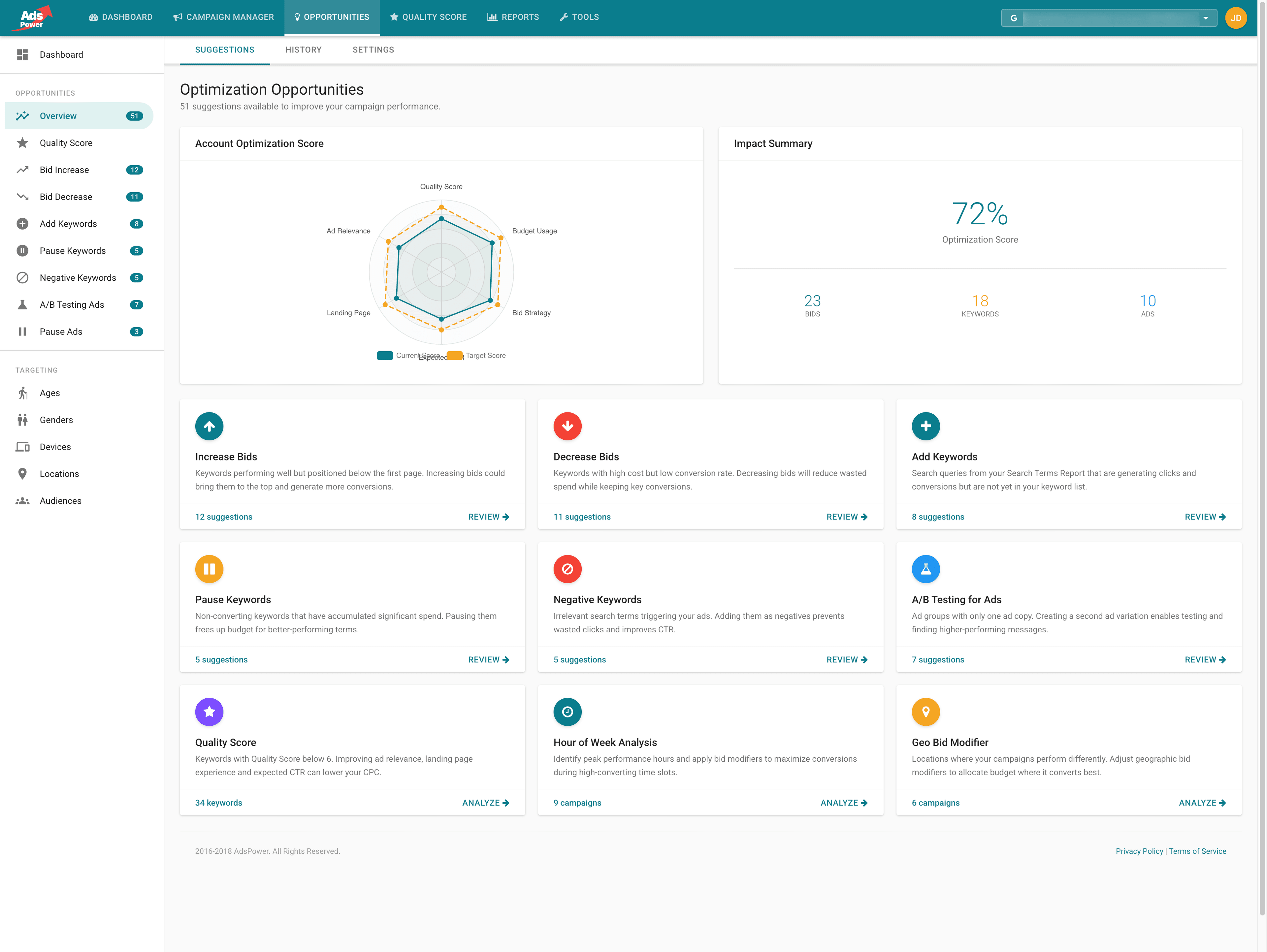
The core concept: ingest thousands of campaign data points - keywords, bids, quality scores, click-through rates, conversion data - feed them into ML classification models, and output actionable optimization recommendations. The platform trained models to predict optimal bid prices, identify high-performing keyword clusters, detect negative keywords draining budgets, and recommend ad copy improvements based on historical performance patterns. The project was directly inspired by Optmyzr and Dolead (French performance marketing platform), both of which were analyzed in depth during our competitive research - their source code, features, and technical approaches were studied to build a competitive product.
3
Ad platform APIs
6
Optimization modules
3
Target platforms
18+
Code repositories
Machine learning techniques implemented for AdWords campaign optimization, inspired by the approaches of Optmyzr and Dolead.
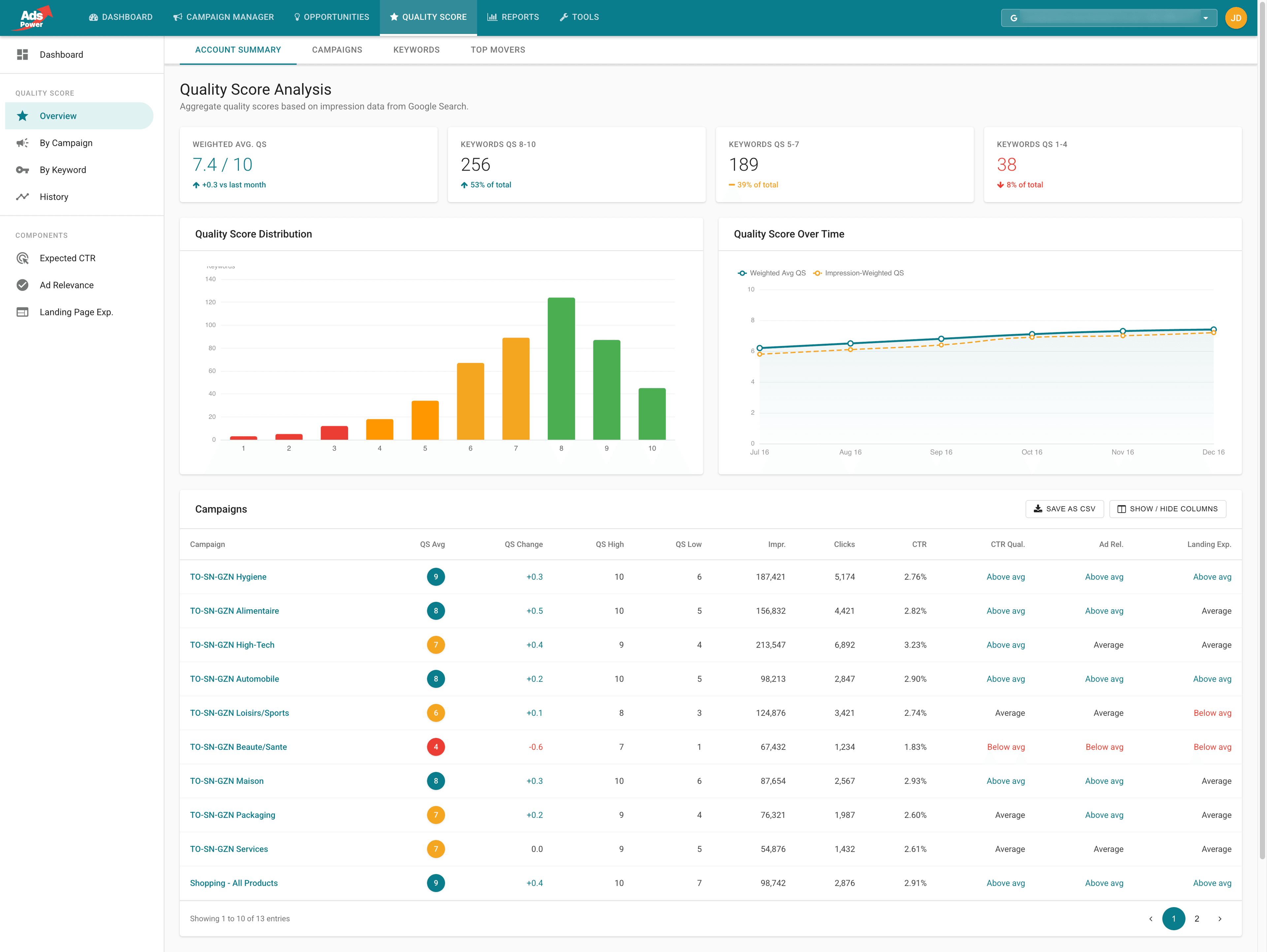
- Supervised learning with classification models (gradient boosting, logistic regression, decision trees) trained on labeled campaign datasets via Azure Machine Learning Studio to predict Quality Score components: expected CTR, ad relevance, and landing page experience
- End-to-end supervised learning workflow on Azure ML: data ingestion from AdWords API exports, feature engineering (match type, device, geo, hour, day, position, historical CTR), model training with cross-validation, hyperparameter tuning, accuracy evaluation (precision, recall, F1), and deployment of trained models as REST web services
- Bid optimization engine using trained classification models to predict conversion probability per keyword and auction context, outputting recommended bid prices for first-page, top-of-page, and first-position placement
- Natural Language Processing (NLP) pipeline using NLTK: tokenization, stemming, stopword removal, and TF-IDF vectorization of keyword and search query data to extract semantic features for ML models
- Unsupervised learning with k-means clustering applied to TF-IDF vectors to group keywords by search intent, discover long-tail keyword opportunities, and automatically detect negative keywords draining ad budgets
- Audience segmentation via supervised classification on demographic data (age, gender) and behavioral patterns using Google Prediction API to target ad groups more precisely
- Multi-engine search scraping (Google, Bing, Yahoo, Yandex, Baidu, DuckDuckGo) to collect competitive intelligence data and feed it into optimization models as additional training features
The problem: in Google AdWords, advertisers buy keywords in broad match. Google then triggers ads on search queries it considers similar, but which often have nothing to do with the campaign's commercial intent. An advertiser selling "professional IT supplies" could see their budget consumed by visitors searching for "free computer courses" or "home PC repair" - paid clicks that will never convert.
The ML solution: the system scraped Google search results (SERP) for each purchased keyword, analyzed the type of displayed results (shopping results, product listings, informational articles, forums..) and extracted the thematic classification and search intent (transactional, informational, navigational). These signals, combined with historical performance data (CTR, conversion rate, cost), were vectorized via TF-IDF and fed into a supervised classification model (gradient boosting on Azure ML).
The result: the model classified each visitor search query as relevant or irrelevant relative to the campaign's commercial objective. Keywords identified as false positives were automatically suggested as negative keywords to be excluded from the campaign. Without this system, it was impossible to systematically detect wasted spend on off-target user intents.
This is just one example among the many optimization algorithms built into the platform.
This project was a formative experience in machine learning. Azure ML Studio served as my training ground for supervised learning: I learned to prepare labeled datasets from raw AdWords campaign exports, engineer meaningful features, select and compare classification algorithms (logistic regression for interpretability, gradient boosting for accuracy, decision trees for explainability), train models with cross-validation splits, evaluate results with confusion matrices and F1 scores, and deploy production-ready models as API endpoints.
In parallel, I built practical NLP skills via NLTK - understanding how to transform raw text (keywords, search queries, ad copy) into numerical vectors via TF-IDF, and how to apply unsupervised k-means clustering to discover patterns in keyword data that no human could spot manually. This combination of supervised classification (predicting bid prices, quality scores) and unsupervised clustering (grouping keywords, segmenting audiences) gave me a solid foundation in applied machine learning that goes far beyond theory.
Backend & Framework
Frontend & SPA
Machine Learning & NLP
Advertising APIs
Data Visualization
Infrastructure & CI/CD
API & Security
- Pioneered the use of Azure Machine Learning for AI-driven advertising optimization
- Drove significant R&D efforts in artificial intelligence for ad campaign management
- Built a multi-platform application: web (Firebase), desktop (Electron for Mac/Win/Linux), and mobile (Cordova for iOS/Android)
- Designed and documented a complete data model covering the Google AdWords, Bing Ads, and Facebook Ads ecosystems
The project was ultimately abandoned due to lack of funding. The R&D cost was too high for a bootstrapped startup with no external financing. The product worked, the models produced real optimization recommendations, but without commercial traction the budget ran out.
- Technical excellence alone doesn't make a viable business. A good product without paying customers remains an R&D project. Commercial validation must advance at the same pace as development.
- Timing matters as much as execution. The AI-driven advertising angle was ahead of the market in 2016 - making the project visionary but also harder to sell to advertisers not yet familiar with machine learning.
- Validate the market before building the product. Too much time invested in technical R&D (multi-platform, 3 ad APIs, advanced ML) and not enough in commercial validation with real paying customers.
- The ability to iterate fast is a lasting asset. 3 major backend versions in under a year, migration from Angular 4 to Angular 10, ML pipeline overhaul - this rapid delivery discipline became a permanent reflex in my career.
AdsPower is the project that immersed me in machine learning and AI. It's the experience that transformed my development vision: going from a classic full-stack developer to a profile capable of designing, training and deploying machine learning models on concrete business problems.
The project was ambitious - probably too much for a bootstrapped startup - but it forged my understanding of how ML can solve real business problems. The AI angle was ahead of its time in 2016, making the project visionary but also harder to sell.
What I take away most: the discipline of iterating fast and the deep practical knowledge of machine learning that I still carry today.
7 Technical Skill · 5 Soft Skill
Technical Skill
Design of machine learning algorithms for ad optimization and predictive targeting.
Managing projects with AI components, coordination between data science and development.
Advertising data analysis to guide strategic decisions and optimize campaigns.
Development of the advertising platform, frontend and backend, integration of ad network APIs.
Design of the AdsPower platform technical architecture.
Setup of the technical infrastructure, deployments, and automation.
Integration of ad network APIs (Google Ads, Facebook Ads) and design of internal APIs.
Soft Skill
Co-founding and co-leading the startup, recruiting and managing the technical team.
Managing development sprints, feature prioritization, product roadmap.
Implementing agile practices within the development team.
Solving complex ML/AI problems in a startup context with limited resources.
Rapid skill development in machine learning and predictive algorithms.